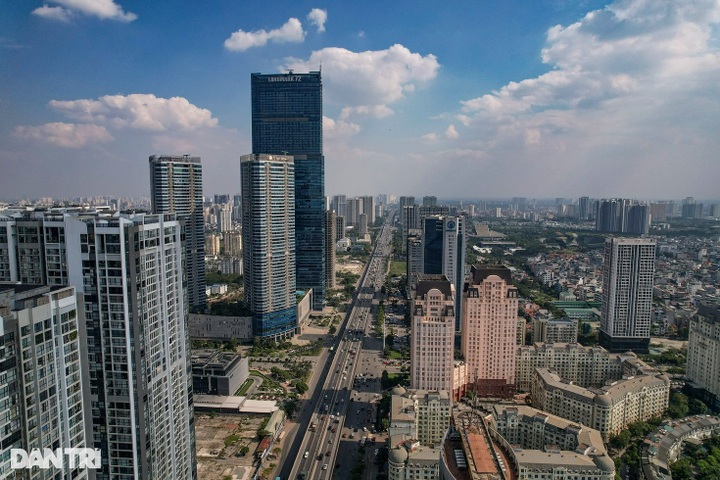
Vietnam is expected to maintain strong growth into 2026-2027. Illustrative photo by Dantri/Dtinews
The Organisation for Economic Co-operation and Development (OECD) has upgraded its medium-term forecast for Vietnam, according to its latest global economic outlook released on December 2. The report signals continued macroeconomic stability despite persistent global trade uncertainty.
OECD notes that 2025 has been a year of strong momentum for Vietnam’s recovery. GDP expanded by 8.2 per cent in the third quarter of 2025, driven by firm final consumption, solid growth in fixed capital formation and buoyant exports of goods and services. Labour market conditions remain resilient, with unemployment steady at 2.2 per cent since the third quarter of 2024, its lowest level on record, while labour force participation continues to rise.
However, OECD warns that external demand is expected to soften in 2026, weighing on exports, a key growth pillar for the highly open and trade-dependent economy.
Domestic demand is expected to remain robust. Rising real wages and employment are set to support consumption, though the planned VAT adjustment in 2027 may temporarily cool spending. Inflation is forecast to edge higher, driven by solid domestic demand, increases in administered prices and the one-off effect of the VAT hike.
Public investment is expected to play a crucial role in sustaining growth. After earlier delays, disbursement is accelerating and is projected to provide a strong anchor for aggregate demand. OECD has upgraded Vietnam’s 2026 forecast by 0.2 percentage points compared with its June 2025 projection.
Exports and FDI continue to underpin growth
Despite global volatility, Vietnam’s exports have remained resilient. In the first nine months of 2025, export turnover rose 15.5 per cent, up from 14.2 per cent in the first half of the year. Shipments to the US, Vietnam’s largest export market, accounting for around 30 per cent of total exports, surged 27.7 per cent even as risks of US import tariffs persist.
Foreign direct investment has also expanded steadily since mid-2023. According to OECD, FDI remains essential not only for capital formation but also for technology diffusion and productivity gains, reinforcing its role as a long-term growth engine.
Fiscal policy is expected to stay expansionary in the near term as the Government accelerates public investment to meet its ambitious 2025 growth target of about 8 per cent. OECD recommends a gradual shift toward a more neutral fiscal stance in the medium term, especially as inflationary pressures build. The temporary VAT reduction from 10 to 8 per cent is set to end in late 2026, adding to upward pressure on prices alongside planned increases in pensions, the minimum wage and public service fees.
Monetary policy has been accommodative since June 2023, with interest rate cuts and direct credit growth targets. OECD notes that rising domestic demand, planned VAT changes and scheduled increases in administered prices will contribute to price pressure through 2026 and 2027. The central bank is advised to closely monitor inflation risks and stand ready to withdraw support if needed.
OECD outlines several downside risks, including a slowdown in global trade from 2026, tighter international investment conditions and policy shifts in major economies that could weaken Vietnam’s export competitiveness or expose it to transshipment-related tariffs.
Reforms could unlock stronger long-term performance
According to OECD, reforms to macroeconomic and structural policy frameworks could yield stronger economic outcomes. Moving toward a more price-based monetary policy could improve resilience and strengthen competition in financial markets, enhancing capital allocation and productivity. Informality, affecting around two-thirds of workers, continues to limit social protection coverage and productivity. Stronger incentives for formal job creation could emerge from reducing the lower labour tax wedge while expanding non-contributory social protection.
Regulatory reforms also hold significant potential. Opening services markets to greater competition and foreign investment could help Vietnam move into higher-value segments of global value chains, as competitive service inputs boost manufacturing productivity. Reducing the dominance of state-owned enterprises and levelling the playing field with private firms could enable labour and capital to shift toward more productive businesses.
Although growth is expected to moderate in 2026-2027, OECD affirms that Vietnam remains one of Asia’s fastest-growing economies. Other major institutions share this view: HSBC recently raised its forecasts to 7.9 per cent for 2025 and 6.7 per cent for 2026, the highest in ASEAN. UOB expects 7.7 per cent growth in 2025, while Standard Chartered projects 7.5 per cent for 2025 and 7.2 per cent for 2026.