
The tropical depression east of the central Philippines is forecast to enter the East Sea, strengthen into Storm No.16 and directly affect Vietnam’s central and south-central regions, bringing moderate to heavy rain from Thua Thien-Hue to Khanh Hoa.
In December, the south-central region may see one to two widespread rain events, with rainfall from southern Quang Tri to the northern part of the south-central coast likely to exceed the long-term average. Authorities warn of heightened risks of flash flooding and landslides.
Cold spells are expected to intensify in December, with severe cold possible in northern mountains. Stronger surges are likely in January and February 2026, while hot conditions may develop from early March in the southeast and spread to the Mekong Delta by late March.
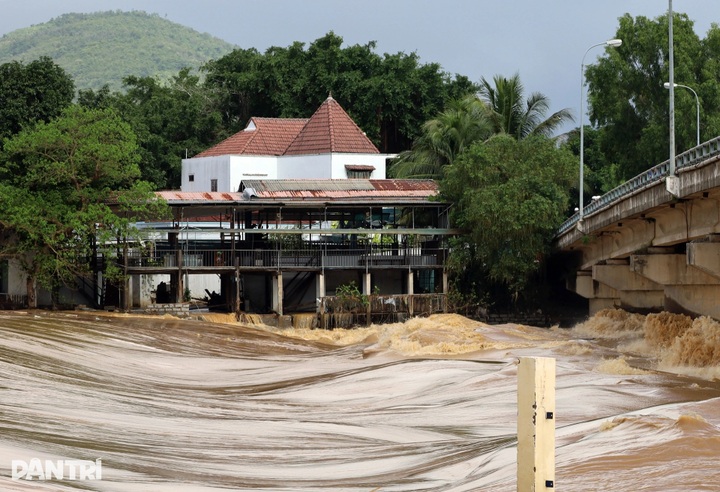
The area near Vinh Phuong Bridge in Bac Nha Trang Ward, Khanh Hoa Province severely flooded on December 4 after torrential rain (Photo by Trung Thi)
The year 2025 has seen extreme and unusual weather across Vietnam, causing economic losses of VND85 trillion (USD3.22 billion), with 409 people reported dead or missing as of late November.
Exceptional or record-breaking floods struck 20 rivers, including the Cau, Thuong, Bang Giang, Lo, Ma, Buoi, Ca, Bo, Vu Gia-Thu Bon, Ky Lo, Ba, Luy, Tien and Hau, affecting regions from north to south.
Historic flooding in the former Phu Yen Province area, now eastern Dak Lak, formed part of a major disaster impacting the central and highland regions, surpassing the 1993 flood peak on the Ba River basin.
The Bach Ma area in Thua Thien-Hue recorded 1,739 mm of rain in 24 hours in October 2025, a figure now being verified by the World Meteorological Organisation as among the highest ever documented globally.
Hoang Duc Cuong, deputy director of the National Hydro-Meteorological Administration, said the El Nino–Southern Oscillation is likely to stay in a La Nina phase from December 2025 to February 2026 before shifting to neutral between March and May 2026.
He said one to two storms or tropical depressions may form over the East Sea in December, while the chance of new systems from January to May 2026 is low.