
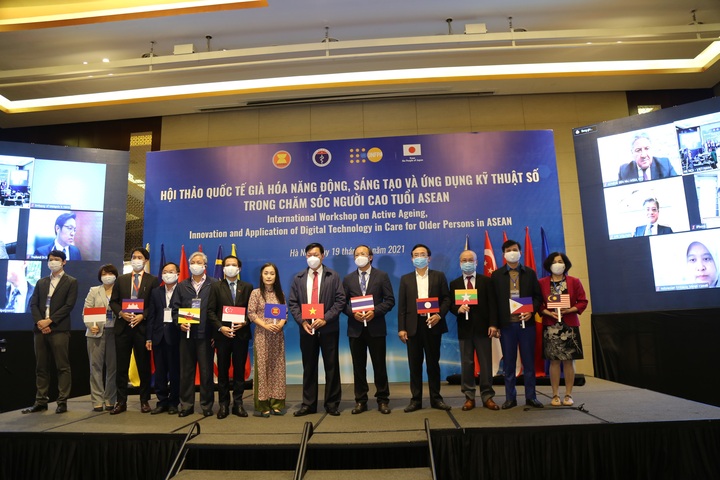
At the event
This is an initiative of Vietnam, as vice chair of ASEAN Centre for Active Ageing and Innovative (ACAI) that is consensus of all ASEAN / ACAI member states.
The workshop was organized in order to promote cooperation and share experiences among ACAI members and between ACAI and development partners on building solidarity, active ageing, and innovation ASEAN community.
Population ageing is a global phenomenon. Virtually every country in the world is experiencing growth in both size and proportion of older persons in the population. Statistics show that in 2019, ASEAN countries have more than 45 million people aged 65 years or over, accounting for 7 percent of total ASEAN’s population. This number is estimated to reach 132 million, accounting for 16.7 percent of total ASEAN’s population by 2050.
Vietnam has officially entered the "ageing phase" since 2011, with the number of older persons (aged 65 years or over) accounting for 7 percent of the total population. Currently, the number of older persons is 7.4 million, accounting for 7.7 per cent of total population. It will increase to 22.3 million, accounting for 20.4 percent by 2050. Vietnam is one of the most rapidly ageing countries in the world.
Addressing the workshop, Vietnamese Vice Minister of Health Do Xuan Tuyen, said, "The Party and the Government of Vietnam always pay attention, care and support and promote the role of older persons. The Resolution No. 21-NQ /TW dated October 25, 2017 of the Central Committee of the Communist Party of Vietnam, emphasizes the importance of proactively adapting to population ageing, enhancing the provision of health care for the elderly, focusing on the application of science and technology”.
In 2020, all ASEAN Member States signed an Agreement to establish the ACAI as a proactive adaptation to population aging in ASEAN. ACAI's primary mission is to support making and implementing policy on active ageing and innovation that through providing information, knowledge and building capacity to each ACAI’s Member State.
Dr. Suwit Wibulpolprasery, Chairman of the ACAI GB emphasized: “Aged people in every country have accumulated huge social, intellectual and maybe also financial capitals. They should be considered as important assets for sustainable community and social development. We shall require substantial social and technology innovations to harness these valuable assets. That’s the main reason why we need ACAI. Our Vietnamese Vice Chair, who will be the upcoming chair of ACAI, has taken the leadership to convene this workshops as a lively kick off of ACAI full activities. ACAI will be up and running from now on, with contributions and leaderships from all member states and partners.”
Addressing the event, Ms. Naomi Kitahara, UNFPA Representative in Vietnam said: “Both population ageing and digitalization are part of the world’s Mega Trends which we all have to respond to. Digital technology is continuing to reshape the way we access health information and care services. The COVID-19 pandemic has only made the trend more visible: digital access has become a new social determinant of health. More than ever, the ability of older people to use digital technologies may affect their health status and quality of life. We leverage the potential of digital technologies for active and healthy ageing by promoting the participation of private sectors and facilitate innovations in the provision of goods and services for older persons.”
Attending in both online and offline the workshop, the participants from 10 ASEAN Member States and Partners have been discussing the current situation, the trend of ageing in ASEAN, care needs of older persons, especially in COVID-19 pandemic. International experts from ASEAN Member States, UNFPA, Japan, MRI, PPD, HelpAge International shared experiences, initiatives for promoting healthy active ageing and innovation in ASEAN community.