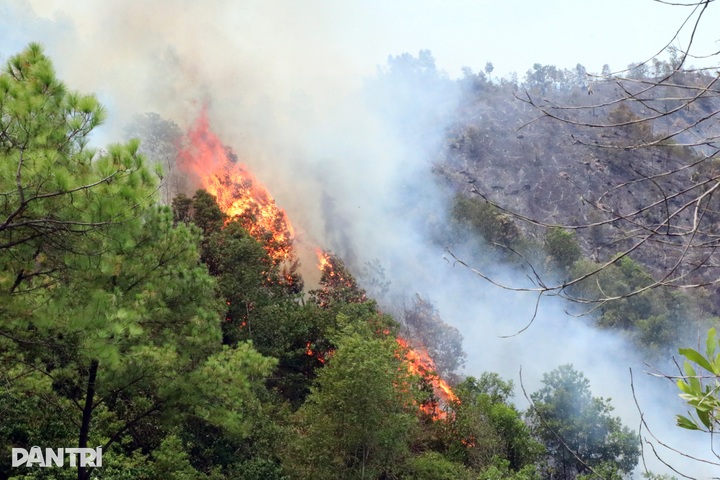
The blaze broke out on the afternoon of June 21 in a mountainous area of Thien Nhan Commune.

Fueled by temperatures exceeding 38 degrees Celsius and strong southwesterly winds, the fire spread rapidly across vegetation-covered hillsides, creating major challenges for emergency crews.


Authorities and local residents deployed multiple firefighting teams to contain the blaze, clearing vegetation, creating firebreaks and establishing containment zones to prevent the flames from spreading to nearby areas.
However, rugged terrain and highly flammable vegetation, including dry grass, reeds and undergrowth, hampered firefighting efforts.
Officials said several hotspots reignited shortly after being brought under control, allowing the fire to continue spreading across hillsides in Thien Nhan Commune on the evening of June 21.
More than 1,000 personnel, including forest rangers, police officers, soldiers and local militia members, remained on the fire lines throughout the night.
Specialised firefighting vehicles and equipment were also deployed to support suppression efforts.


Due to the prolonged operation, some exhausted personnel were withdrawn for rest on June 22 while additional forces were mobilised to reinforce crews at the scene.

Local authorities have advised residents living at the foot of the mountains to move valuable belongings to safer locations and prepare for evacuation if required.

Preliminary assessments suggest the fire may have started when local residents were clearing vegetation for acacia plantations, causing flames to spread into surrounding forest areas.
Officials noted that the affected area was previously covered by pine forest that had been damaged by earlier fires and is now dominated by regenerating vegetation and dense undergrowth.
Nghe An Province has experienced a prolonged heatwave over the past five days, with temperatures generally ranging between 37 and 38 degrees Celsius.
On June 22, authorities issued forest fire warnings for 117 locations across the province, ranging from Level 3 to Level 5 risk, due to persistent dry weather and an extended lack of rainfall.