A herd of endangered spotted deer has expanded from just three rescued animals to nearly 40 at a semi-wild conservation centre in Gia Lai Province, highlighting the success of a long-term wildlife rehabilitation programme.
The herd is being cared for at the Rescue, Conservation and Wildlife Development Centre, a 10-hectare facility located deep within the core zone of Kon Ka Kinh National Park in Ayun Commune.
The centre rescues, rehabilitates and conserves rare wild animals that have been caught in traps or found by local residents. Among them are spotted deer and sambar deer, which are raised in a semi-wild environment designed to restore their natural behaviours.

A rare herd of spotted deer in Kon Ka Kinh National Park forest (Photo: Pham Hoang).
Tran Van Thu, director of the Rescue, Conservation and Wildlife Development Centre, said the facility received its first three emaciated spotted deer in 2013.
In 2020, Hoang Anh Gia Lai Joint Stock Company transferred more than 20 spotted deer and sambar deer to Kon Ka Kinh National Park for long-term care.
According to Tran Van Thu, many of the rescued animals arrived in poor physical and psychological condition after years in captivity. Some suffered from skin diseases, digestive disorders and severe malnutrition, while others displayed signs of prolonged stress.

The spotted deer herd has recovered strongly in the semi-wild habitat (Photo: Chi Anh).
The rehabilitation programme focused not only on treating illness but also on helping the animals regain natural instincts that had diminished during captivity.
Despite intensive veterinary care, three to four animals died from old age or irreversible health conditions. The surviving deer were treated for skin infections and digestive problems and received nutritional and mineral supplements to restore their health.
After adapting to the semi-wild habitat, the spotted deer became noticeably healthier, with fewer illnesses and significantly improved breeding success.
"From the initial three spotted deer, the centre has now developed a healthy herd of around 40 animals. Many fawns have been born and raised in the semi-wild environment, steadily increasing the population over the years," Tran Van Thu said.
The spotted deer at Kon Ka Kinh National Park now weigh between 30kg and 70kg. The centre also cares for seven sambar deer, which remain highly wary of people and typically flee when approached by visitors.
Ngo Van Thang, director of Kon Ka Kinh National Park, said the 10-hectare conservation area occupies a naturally flat valley with extensive grassland, providing an ideal setting for a semi-wild rescue facility.
He said the park plans to develop three tourism products between 2026 and 2030: educational tours focused on environmental awareness, adventure tourism and nature-based leisure experiences. The strategy is intended to balance tourism development with biodiversity conservation while protecting valuable genetic resources.
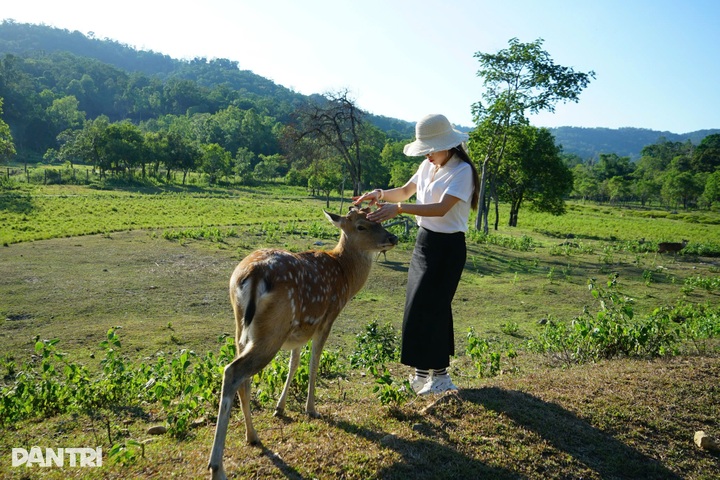
The spotted deer enclosure has become an attractive experiential tourism site for visitors to Kon Ka Kinh National Park (Photo: Pham Hoang).
Kon Ka Kinh National Park covers nearly 42,000 hectares, of which 93.82 per cent is natural forest. It contains around 2,000 hectares of mixed broadleaf and conifer forest, regarded as the only ecosystem of its kind within Vietnam's national system of special-use forests.
The park is considered one of the Central Highlands' richest biodiversity hotspots, supporting 876 animal species, including 16 endemic species and 93 rare species listed in the Vietnam Red Data Book and international conservation lists. Its flora comprises 1,754 plant species, including valuable timber and aromatic trees such as Fujian cypress, red ironwood, Nageia and agarwood.