According to Pham Duc Luan, head of the Department of Dyke Management and Natural Disaster Prevention under the Ministry of Agriculture and Environment, natural disasters in recent years have become increasingly severe and extreme, taking many forms.
In particular, in two consecutive years, 2024 and 2025, exceptionally heavy post-storm rain and flooding lasted for days, setting new historic floodwater records and threatening the safety of the dyke system.

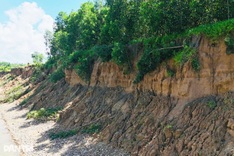
Floodwaters threaten dyke safety in Hai Duong Province (Photo: Nguyen Duong).
In 2024, super typhoon Yagi struck with exceptional intensity, causing widespread destruction across 26 provinces and cities in the northern region and Thanh Hoa Province.
The storm's circulation brought prolonged heavy rain and exceptionally large-scale flooding, with most rivers rising above warning level three. Historic floods were recorded on several rivers in the Red River and Thai Binh river systems. Reservoirs had to release floodwaters, and at one point inflows into Thac Ba reservoir exceeded its designed discharge capacity, raising the risk to dam safety.
Prolonged heavy rain also triggered landslides, flash floods and torrents across most mountainous and midland provinces in northern Vietnam.
Damage statistics show that in 2024, natural disasters left 513 people dead or missing, caused more than 800 dyke incidents, and damaged or swept away numerous structures, homes, livestock and crops.
In 2025, natural disasters continued to strike in rapid succession across a wide area, with increasingly extreme, unusual and record-breaking characteristics. It was one of the busiest years on record in the East Sea, with 15 storms and six tropical depressions.
Storm Bualoi, in late September 2025, brought major flooding to river systems in northern Vietnam and the north-central region, with many rivers reaching warning level three or higher. Floodwaters on the Buoi River at Kim Tan in Thanh Hoa Province surpassed the historic 2007 level.
Shortly afterwards, Storm Matmo, in early October 2025, triggered another exceptionally large flood event across northern river systems. Flood levels on the Cau, Thuong and Ca Lo rivers exceeded historic records.
"This was a compound disaster pattern, with storm upon storm and flood upon flood, causing historic flooding and a large number of dyke incidents, including many particularly serious ones that threatened the flood defence capacity of the dykes," Luan said. "Anti-overtopping measures had to be deployed at a very high level across almost the entire system. Main dykes along the Cau and Thuong rivers were overtopped for more than 26.5 kilometres."
Prolonged heavy rain and flooding also hit central Vietnam after Storms Fengshen and Tino in late October and November 2025. Hue recorded exceptionally heavy rainfall of 1,200 to 2,200mm, with some places receiving more than 6,000mm. Dak Lak recorded 800 to 1,500mm, with some areas exceeding 1,900mm. This caused exceptionally large floods on the Bo River in Hue, the Thu Bon River in Danang, the Ba River in Dak Lak and the Dinh River in Khanh Hoa Province, all above historic levels. As a result, widespread deep flooding inundated many areas, with particularly severe impacts in Dak Lak, formerly Phu Yen Province, and Khanh Hoa Province.
Flood inflows into reservoirs were exceptionally high. Song Ba Ha hydropower plant had to open 12 spillway gates, discharging 16,100 cubic metres per second, the highest level ever recorded.
Luan cited statistics showing that in 2025, natural disasters left 484 people dead or missing, injured 811 others, caused 185 dyke incidents, and damaged or swept away numerous structures, homes, livestock and crops. Total economic losses were estimated at nearly VND 105 trillion (USD 4.1 billion).
Drawing on years of directing flood and storm prevention efforts, especially in 2024 and 2025, Pham Duc Luan said the role of specialist dyke management forces in protecting dykes and handling incidents was crucial to ensuring the safety of the dyke system.
These teams provide direct technical advice and are deployed to deal with dyke incidents from the earliest hours, helping to keep dykes safe and limit losses caused by floods and storms.

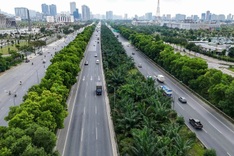
A section of dyke road in Hanoi City (Photo: Huu Nghi).
At a recent conference, the Department of Dyke Management and Natural Disaster Prevention reviewed the course of exceptionally large post-storm floods, assessed the condition of the dyke system, riverbanks and river channels, and examined emergency response and dyke protection efforts aimed at safeguarding the system.
It also highlighted shortcomings, difficulties, obstacles and lessons learned, while proposing measures for the period ahead to support management, direction and operations, with the goal of keeping dykes safe and protecting the lives and property of the state and the public.
More than 9,708km of dykes
Vietnam currently has more than 9,700 kilometres of dykes and a vast number of associated structures, including more than 1,035 kilometres of embankments protecting dykes, more than 1,500 sluices beneath dykes and more than 1,400 dyke watch posts.
The dyke system is designed to provide comprehensive flood and storm protection, concentrated mainly in northern Vietnam and the north-central region. In addition, the Mekong Delta has around 45,500 kilometres of ring dykes and embankments of various kinds.
Because the dyke system is extensive, long-established and built mainly of earth, it is frequently damaged and degraded by natural disasters, with many vulnerable sections remaining.