Hanoi People's Committee Chairman Vu Dai Thang has signed a decision introducing new regulations on the management of parks, trees and water bodies across the capital.
Under the regulations, tree planting must comply with urban planning, technical standards and landscape requirements while taking account of local climate and soil conditions.

Trees must also be safe for pedestrians, vehicles and nearby buildings, with species that release harmful substances, attract insects, produce unpleasant-smelling fruit or have brittle branches and sharp thorns restricted.
The decision identifies eight categories of prohibited activities, including planting banned species, unauthorised planting in public spaces and cutting, moving or pruning trees without permission.
Damaging trees by drilling, hammering nails, stripping bark or cutting roots is also prohibited, as is dumping waste or construction materials around their bases.
Attaching advertising signs, decorative lights or cables to trees without approval is banned, along with illegal construction on designated green spaces.
Hanoi has published lists of 33 tree species suitable for streets and public areas, 18 aquatic and semi-aquatic species, and 18 species prohibited from planting.
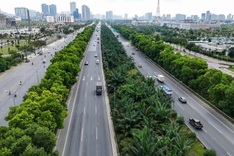
Approved roadside species include camphor, golden shower trees, magnolias, flamboyant trees, mango trees and several native hardwood species.
Aquatic and semi-aquatic plants include bald cypress, paperbark trees, water lilies, lotus and water hyacinth.
The prohibited list includes rubber trees, ornamental coca, strychnine trees, monkshood, oleander, yellow oleander, Jamaican cherry and Baccaurea fruit trees, among others.
Authorities cited concerns over toxicity, structural weakness, addictive substances and other hazards associated with the banned species.
According to the Hanoi Department of Construction, the capital currently has around 26,400 Dracontomelon trees, 17,500 crape myrtles, 16,000 flamboyant trees, 14,400 blackboard trees and 10,400 African mahogany trees.
The city has also approved a broader plan to improve the management of trees, parks, gardens and water bodies.
The strategy marks a shift from simply planting trees to managing urban green infrastructure as an integrated, long-term system.
Looking beyond 2030, with a 100-year vision, Hanoi aims to treat trees and water bodies as essential ecological infrastructure rather than focusing solely on planting numbers.