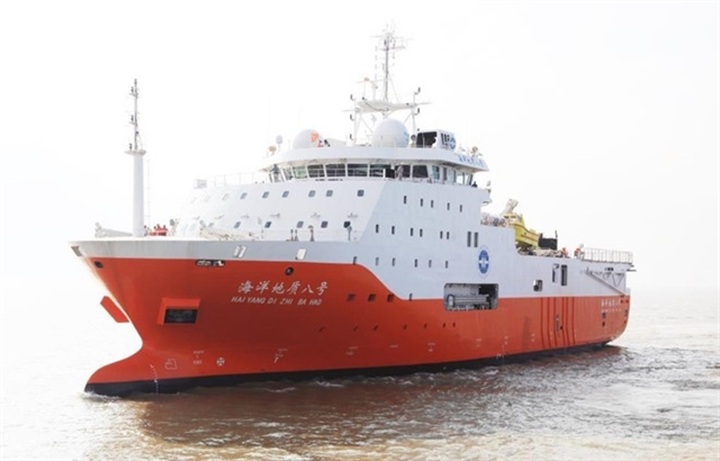
A survey ship Haiyang Dizhi 8 of China. Tension escalated in the East Sea since the ship and its escort vessels returned to Việt Nam’s Exclusive Economic Zone (EEZ) on August 13. Photo thoidai.com.vn
Tension escalated since the Chinese survey ship Haiyang Dizhi 8 and its escort vessels returned to Vietnam’s Exclusive Economic Zone (EEZ) earlier this month.
China’s behaviour had become more challenging as the country had deployed more ships to the East Sea than before, said Gregory B Poling, Director of the Asia Maritime Transparency Initiative (AMTI) and a fellow with the Southeast Asia Programme at the US’s Centre for Strategic and International Studies (CSIS).
He urged Southeast Asian nations to demonstrate a clear viewpoint in protecting their rights in line with international law.
Echoing Poling’s view, professor Stein Tonnesson from the Peace Research Institute Oslo said China deterring regional countries from conducting lawful activities in the East Sea and interfering in Vietnam’s oil and gas mining in its EEZ was systematic.
He advised Southeast Asian countries to push for talks in order to seek rational and practical solutions.As ASEAN Chair next year and a non-permanent member of the UN Security Council for the 2020–21 term, Vietnam would be positioned to beef up dialogue and negotiations, said professor Kavi Chongkittavorn, Senior Fellow at the Institute of Security and International Studies, Thailand’s Chulalongkorn University.
E3 countries concerns
In a joint statement issued on Thursday, the E3 countries of France, Germany and United Kingdom expressed their concerns about the situation in the East Sea “which could lead to insecurity and instability in the region”.
They called on all coastal nations to take steps that “reduce tensions and contribute to maintaining and promoting peace, security, stability and safety in the region, including as regards the rights of coastal States in their waters and the freedom and rights of navigation in and overflight above the East Sea,” according to the statement.
The statement stresses the three countries’ role as State parties of the United Nations Convention on the Law of the Sea (UNCLOS) and highlights their interest in the application of the convention, which “sets out the comprehensive legal framework within which all activities in the oceans and seas including in the South China Sea (called East Sea by Vietnam) must be carried out and which provides the basis for national, regional and global co-operation in the maritime domain.”