Located in the strictly protected zone of Phong Nha-Ke Bang National Park in Quang Tri Province, Hang Thang, or Victory Cave, was first surveyed by an exploration team in June. The cave was named after Nguyen Quyet Thang, a local resident who discovered its entrance.

Victory Cave is 3,000 metres long and averages 70 metres in width, reaching more than 100 metres at some points. It has two entrances and divides into two separate branches. Large formations of stalactites and other cave deposits cover almost its entire length.
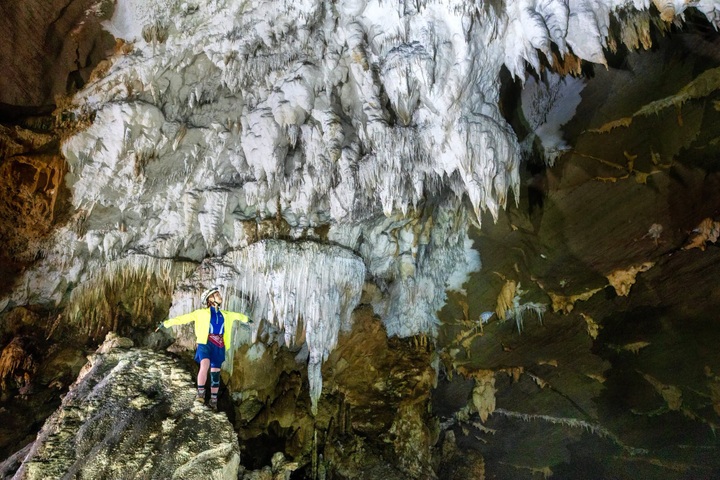
A striking stalactite formation inside Victory Cave.

Although the cave was surveyed in June, it was not until October, when the rainy season began, that the exploration team witnessed its calcite pools filled with striking turquoise water for the first time.
In the preceding months, the team had recorded winding calcite rims across the cave floor, along with distinct marks on the rock walls showing previous water levels of up to about three metres.

Numerous winding mineral ridges divide the water into a series of interconnected pools at different levels.
The calcite pool system in Victory Cave formed through the natural movement of water and the precipitation of minerals. As water flows down from the ceiling and walls, it helps shape depressions in the cave floor. Calcium carbonate gradually precipitates and accumulates, forming mineral ridges.
Over time, these ridges develop into natural barriers that hold back water, creating multi-tiered pools with delicate, flowing outlines that resemble an intricately carved structure.

Deeper inside the cave, the vast pools leave explorers increasingly astonished. Some cover 100-200 square metres, while the largest reach up to 500 square metres.

According to observations by exploration company Jungle Boss, water typically begins accumulating in the calcite pools around October and may remain until March the following year, depending on rainfall and drainage conditions inside the cave.
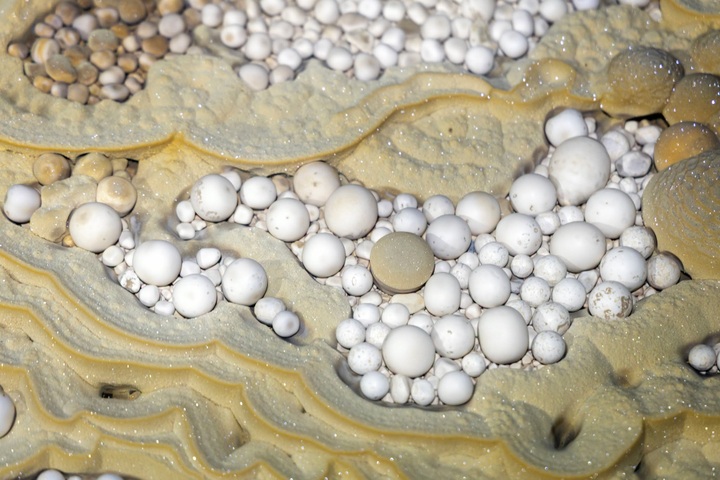
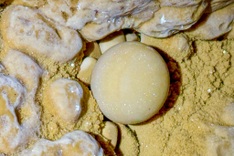
Beyond its calcite pools, Victory Cave also contains a spectacular collection of cave pearls. These usually form on the cave floor, often in small calcite pools where water seeps through the ceiling and drips onto the ground. Depending on the mineral content of the dripping water, the cave pearls can be yellow or white.

In some areas, the floor is densely covered with smooth, rounded pearls whose surfaces gleam under artificial light. Elsewhere, smaller, less developed specimens are embedded in mineral deposits that are still forming.

The variety is evident even within a single area. Cave pearls come in spherical, elliptical, flattened disc-shaped and short cylindrical forms, as well as other shapes. Their colours range from bright white and cream to dull yellow.

Rounded cave pearls sit in natural hollows in the rock, providing evidence of the remarkable geological processes taking place inside Victory Cave.
The cave reveals multiple stages of cave pearl formation within the same area, from newly formed specimens and those still taking shape to larger, smooth, rounded pearls that have developed over thousands of years.
Photos: Jungle Boss