The Nguyen dynasty throne was returned to its original position in the centre of Thai Hoa Palace inside the Hue Imperial Citadel on June 4, more than a year after it was damaged in an act of vandalism.

The Nguyen dynasty royal throne before it was damaged by a visitor (Photo: Vi Thao).
According to Hoang Viet Trung, director of the Hue Monuments Conservation Centre, the restoration of the national treasure was carried out carefully and rigorously in accordance with legal requirements and professional heritage conservation standards.
Restoration work took place between April 22 and May 4 at the Hue Museum of Royal Antiquities. Throughout the process, a panel of experts closely monitored and inspected every stage to ensure compliance with scientific, technical and conservation principles.
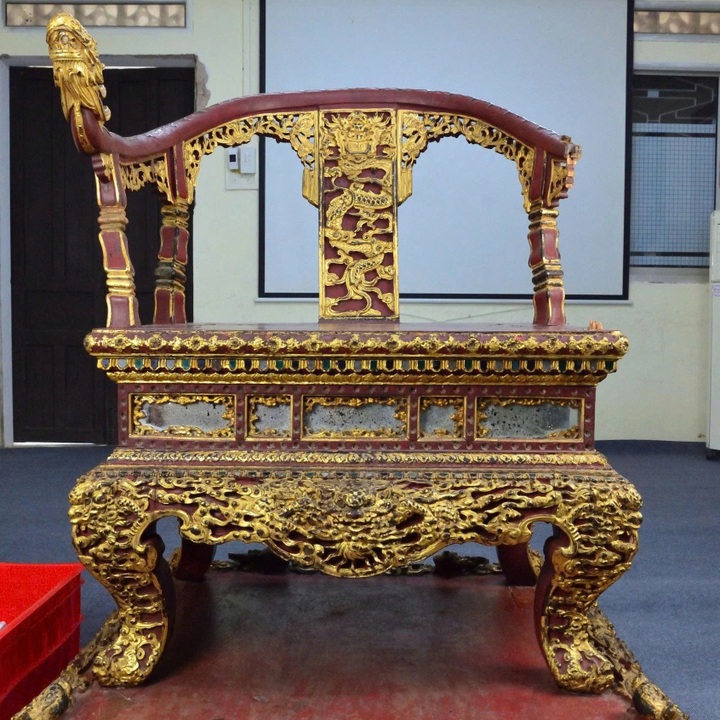
The Nguyen dynasty royal throne after it was vandalised by a visitor (Source: Hue Monuments Conservation Centre).
The restoration followed internationally recognised conservation practices, prioritising the preservation of original elements, the use of materials compatible with the throne's original construction and minimal intervention techniques that avoided altering or renewing the artefact.
Artisans undertaking the project reused as many of the original broken fragments as possible to maintain the throne's authenticity, structural stability and historical value.
The team cleaned the artefact, treated it for mould and insect damage and successfully reassembled the 14 fragments of the throne's left armrest that had been broken during the incident. Craftsmen used matching wood and a mixture of fine wood powder and traditional lacquer to repair cracks and missing sections, restore connecting joints and stabilise damaged areas using specialist adhesives.
Missing sections were reconstructed using traditional restoration techniques.
The final stage included the application of a thin, transparent protective coating that preserved the throne's original appearance without altering its aesthetic value.

The national treasure underwent a strict restoration process in line with regulations (Source: Hue Monuments Conservation Centre).
Trung said the entire restoration process was documented through photographs, video recordings and detailed technical records, which will be archived for future management, research, conservation and transparency purposes.
Following restoration, the throne has regained its structural integrity, with the damaged armrest restored to its original shape, dimensions and colour in accordance with documentation used for its recognition as a National Treasure in 2015.
No new decorative motifs or patterns were added during the process, ensuring that the artefact's original features remained unchanged.
The Nguyen dynasty throne is one of the most important artefacts within Hue's royal heritage collection. It was officially recognised as a National Treasure by the Prime Minister in 2015 and is normally displayed inside Thai Hoa Palace, part of the Complex of Hue Monuments.
On May 24, 2025, Ho Van Phuong Tam, a 42-year-old resident of Hue, purchased an entrance ticket to the historic site before climbing onto the throne area and causing damage.
The incident resulted in the left armrest being broken into 14 separate pieces of varying sizes.
Following the attack, the throne was removed and placed in secure storage at the Hue Museum of Royal Antiquities.
The broken fragments were initially collected by investigators from the Hue City Police Department as evidence before being returned to the museum for restoration work.