Archaeological excavations near Hai Van Pass in Danang have uncovered new evidence about the scale, layout and historical role of two Nguyen Dynasty defence sites that once guarded the northern gateway to Danang Bay.
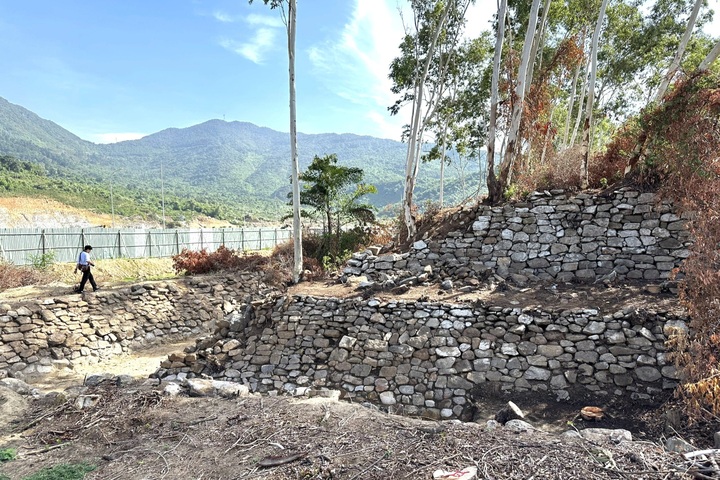
Stone architectural remains uncovered at the Nam Chon station excavation area (Photo: Hung Loi).
The Danang Monuments and Scenic Sites Management Board said excavation work at both sites had been completed. Specialists are now cataloguing artefacts, preparing a scientific report and preserving the newly exposed remains.
Preliminary findings suggest that Nam Chon Station originally served as a relay post on the historic Thien Ly route before being reinforced with defensive functions. Chon Sang Fort is believed to have been a military installation within the Nguyen Dynasty's defensive network in Danang, helping control movement through the southern foothills of Hai Van Pass.
The two sites occupy a strategic position on Vietnam's north-south route and formed part of the defensive complex at the southern foot of Hai Van Pass. They are also linked to the campaign against the Franco-Spanish expeditionary force during the Siege of Danang between 1858 and 1860. Researchers said further study is needed to determine the precise construction dates, development phases and functions of individual architectural features.
At Nam Chon Station, six excavation trenches covering a total of 300 square metres revealed several key structural elements. Combined with field surveys, the findings indicate the site had an almost square layout measuring approximately 114 by 108.5 metres, broadly aligned with the four cardinal directions.
Archaeologists uncovered remnants of surrounding defensive walls, a moat and stepped stone-reinforced fortifications enclosing the central area. They also identified the remains of an entrance and a road about 2.5 metres wide, which may have connected to the historic Thien Ly route to the northwest.
The excavation yielded Nguyen Dynasty bricks and roof tiles. Within the central area, researchers found a brick-paved foundation, stone edging and column bases, indicating that a substantial structure once stood inside the station. Its exact form and function remain under investigation.
A total of 904 artefacts were recovered from Nam Chon Station, mainly architectural materials and ceramics dating from the Tran Dynasty to the Nguyen Dynasty. The discoveries point to long-term occupation and activity at the site, although they are not yet sufficient to determine when all of the surviving structures were built.
At Chon Sang Fort, archaeologists excavated another 300 square metres, exposing the foundations of a central building, stone column bases, raised platforms and a stone staircase with 13 steps. The layout suggests the remains of a multi-room structure, although the names and functions of its individual sections have yet to be established.
Researchers also identified spiral-shaped stone structures at the fort's western and southern corners. They believe these may have served as observation or defensive positions, although additional evidence will be required to confirm their purpose.
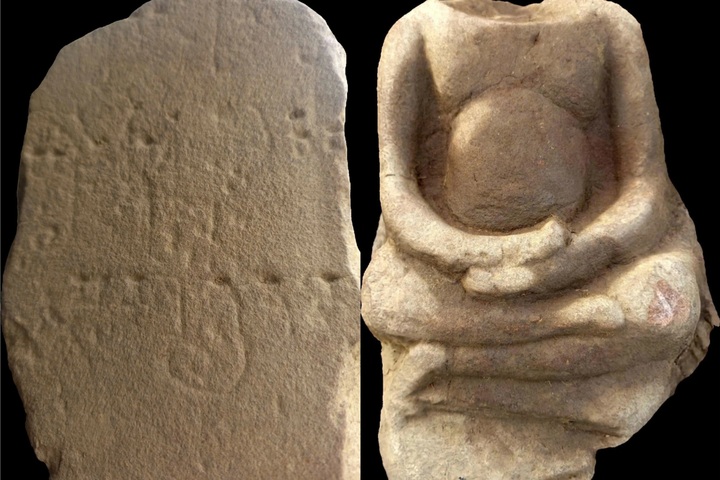
A sandstone relief fragment discovered at the relic site (Photo: Danang City Heritage and Scenic Sites Management Board).
The excavation at Chon Sang Fort produced 60 artefacts, including architectural materials, ceramics and a sandstone relief fragment. Preliminary analysis suggests the relief may be linked to Cham culture, opening new avenues for research into the area's settlement history and cultural exchange. However, researchers said the discovery cannot yet be used to determine the age of the military site.
Experts said the significance of Nam Chon Station and Chon Sang Fort extends beyond their architectural remains to their role within the defensive system protecting the northern approaches to Danang Bay. Considered alongside Hai Van Gate, Dien Hai Citadel, An Hai Citadel and nearby coastal forts, the two sites provide fresh insight into the multi-layered defence strategy employed by the Nguyen Dynasty in Danang during the 19th century.
The Danang Monuments and Scenic Sites Management Board said the sites will be preserved while specialists complete artefact conservation and scientific documentation. Authorities also plan to prepare dossiers seeking city-level heritage recognition, with consideration of higher-level designation to follow once further historical and archaeological research has been completed.