Deputy PM Vu Duc Dam asserted that HIV/AIDS prevention and control are regarded as the Vietnamese Government’s prioritized task in his speech at the UN General Assembly high-level meeting on HIV/AIDS in New York on June 9.
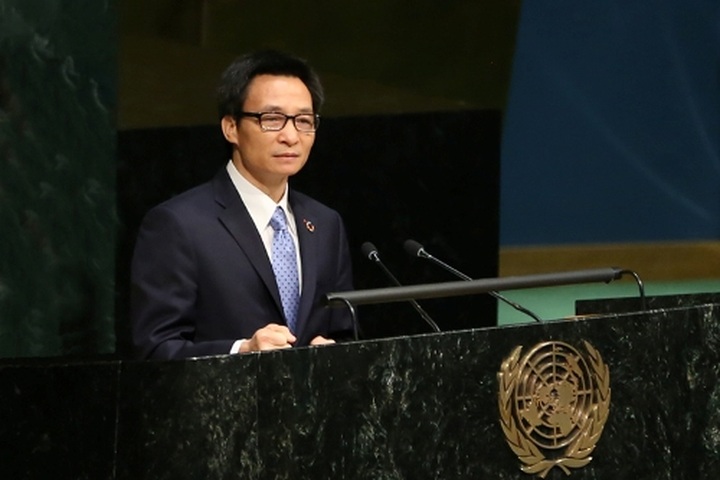 |
Photo: VGP/Dinh Nam |
HIV/AIDS is expected to end by 2030.
Viet Nam has continuously increased resources for HIV/AIDS prevention and control and become one of the top Asian-Pacific nations to respond to the UN’s the 90-90-90 targets.
The Deputy PM called for maintaining assistance for HIV/AIDS carriers, encouraging the international sponsors to help people living with HIV/AIDS and vulnerable ones so to end the disease by 2030.
At the meeting, the Vietnamese delegation joined a number of discussions related to measures to mobilize resources for struggling against HIV/AIDS.
The Vietnamese Government continues investment in HIV prevention and control programs such as increasing the State and local budgets for the activity and rising the health insurance fund.
Deputy Minister of Health Nguyen Thanh Long said that the international community highly appraised Viet Nam’s efforts and experience in HIV/AIDS prevention and control in terms of the reduction of the number of new HIV/AIDS carriers and the HIV transmission from mothers to their infants and the highest number of drug addicts using Methadone in the region.
The United Nations Wednesday adopted a progressive, new and actionable Political Declaration on Ending AIDS which includes a set of specific, time-bound targets that must be reached by 2020 to end the AIDS epidemic by 2030 within the framework of the Sustainable Development Goals.
The declaration was adopted by member states during the United Nations General Assembly High-Level Meeting on Ending AIDS, now underway in New York.
Caribbean Community (CARICOM) countries met ahead of the conference to put forward a regional approach to the meeting.
Heads of State and Government, ministers, people living with HIV, representatives of civil society, international organizations, the private sector, scientists and researchers have gathered to build on the commitments made in the Political Declaration and to set the world on course to end the AIDS epidemic as a public health threat by 2030.
The global community is united in its resolve to end the AIDS epidemic within the framework of the Sustainable Development Goals, said the President of the United Nations General Assembly, Mogens Lykketoft.
By December 2015, 17 million people were accessing antiretroviral medicines and new HIV infections among children and AIDS-related deaths have been considerably reduced. There has also been progress in reducing tuberculosis deaths among people living with HIV.
However, the number of new HIV infections among adults has remained almost static since 2010 and too many people are being left behind in the response, including young women and girls and specific groups of people, including sex workers, prisoners, gay men and other men who have sex with men, transgender people and people who inject drugs.
The High-Level Meeting on Ending AIDS will focus attention on the importance of a Fast-Track approach to HIV over the next five years to set the world on course to end the AIDS epidemic.
The UNAIDS Fast-Track approach to ending the AIDS epidemic has a set of time-bound targets, including reducing the number of people newly infected with HIV from 2.1 million in 2015 to fewer than 500 000 in 2020, reducing the number of people dying from AIDS-related illnesses from 1.1 million [940 000–1.3 million] in 2015 to fewer than 500 000 in 2020 and eliminating HIV-related discrimination.