 |
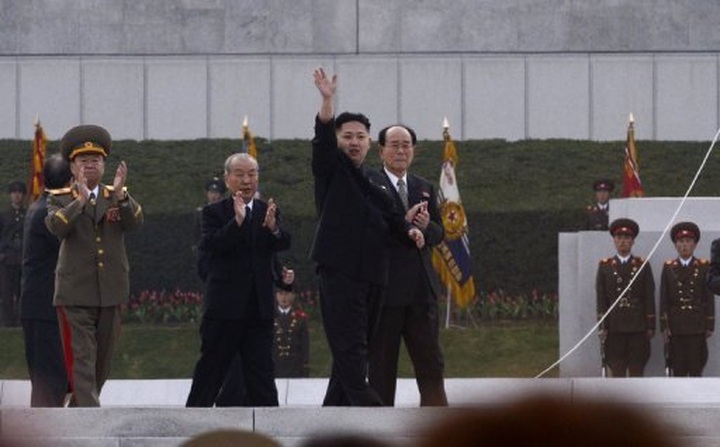
| North Korean leader Kim Jong-Un (C) attends the unveiling ceremony of two statues of former leaders Kim Il-Sung and Kim Jong-Il, in Pyongyang, on April 13. |
Susan Rice, the US ambassador to the United Nations and the council president for April, said it "deplored this launch" as a violation of the world body's resolutions.
The 15-member Security Council is still negotiating a possible "presidential statement" on the North Korean launch but diplomats said China had so far blocked moves to use stronger language.
It was "premature" to say what kind of measure the council might take, but the United States "thinks a credible reaction is important," Rice said.
China has yet to say publicly that it considers the North Korean act a breach of UN resolutions or international law, but US Secretary of State Hillary Clinton urged Beijing to do more.
Clinton spoke by telephone with Chinese Foreign Minister Yang Jiechi as she sought a "unified way to speak out and condemn this action," State Department spokesman Mark Toner said.
"We're asking them to use their relationship with North Korea to convey our concern about their recent actions," Toner told reporters.
Russia, China and India, which are also on the Security Council, have been more measured, urging all parties to show restraint.
The most heated reaction to the politically explosive test has come from the United States, Japan, South Korea and European nations.
Japan and South Korea, which are on the frontline, have demanded tough UN action on North Korea, which is now led by Kim Jong-Un who took over after his father Kim Jong-Il died last December.
The test was supposed to have been the centerpiece of weekend commemorations marking the centenary of the birth of North Korean founding leader Kim Il-Sung.
But the rocket flew for just over two minutes before it broke up and fell into the Yellow Sea, with the North admitting four hours later that the satellite had failed to enter orbit.
The United States had already suspended a plan to deliver 240,000 metric tons of food assistance aimed mainly at children and pregnant women as North Korea prepared for the rocket launch.
President Barack Obama's administration, which had fine-tuned the aid package for months before announcing it February 29, said it was "impossible" to move forward given the state's actions.
"Their efforts to launch a missile clearly demonstrate that they could not be trusted to keep their commitments," deputy national security advisor Ben Rhodes said aboard Air Force One en route to Colombia for an Americas summit.
"Therefore we are not going forward with an agreement to provide them with any assistance."