The Ho Chi Minh City Goods Transport Association has petitioned the Prime Minister and concerned ministries to review the Transport Ministry’s planned road maintenance fee, which the organisation says is both unaffordable and unjust.
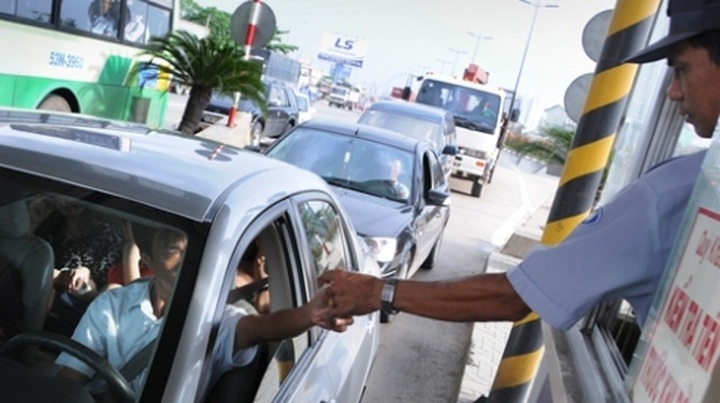
A car driver pays traffic fee at a fee collection station (Photo: Tuoi Tre)
Such a fee, which is to be collected from June 1, 2012 under Decree 18 of the Government, will push transporters to the wall, lawyer Thai Van Chung, general secretary of the association, told Tuoi Tre yesterday.
“Although the concerned ministries have yet to issue any circular to guide the implementation of the Decree, we have anticipated that the fee will put transport businesses into a bad spot. Therefore, we propose that the Government and the ministries of Transport and Finance reconsider the fee rates and the fee collection method,” Chung said.
Under the ministry’s fee collection plan, the lowest fee rate of VND180,000 (US$8.65) per month will be levied on under-12-seat cars and under-2-ton trucks, while the highest rate, VND1.44 million ($69.2) per month, will be applied to over-18-ton trucks and 40’’ container trucks.
In general, these fee rates will exacerbate the already difficult financial situation facing transporters, Chung added. “For example, a goods transporter that operates from Cat Lai port, HCMC to Can Tho Province is currently paying tolls that eat up 19 percent of its revenue from the trip. In addition the transporter has to pay many other high expenses like fuel, loan interest, tires and tubes and so on.”
Therefore, if the new fee is applied, it will worsen the situation and make the business unprofitable, Chung said.
“In order to lower the fees payable by road users, relevant agencies should closely control the quality of roads. If they are built in accordance with the quality standards, then repair expenses, which are sourced from the fee revenue, will be minimized.”
He also pointed out that the investment in roads and bridges in Vietnam is too costly, which may have led to the setting of traffic fees at high rates. “For example, one kilometer of the HCMC-Trung Luong expressway cost about $8 million, eight times higher than a similar road in the US.”
Unfair levying of fee
According to the fee collection method proposed by the Transport Ministry, the fee will be levied on the number of vehicles an individual or organization owns, and such a method is unfair, Chung said.
A person or a company can own many vehicles at a time but they may use only one or a few of them. Therefore, it is unreasonable to force that person or company to pay the fee for all the vehicles that are not being used, Chung said.
“Such a method will lead to inequality among fee payers.”
More irrationally, as well as being unaffordable, is that the fee is set to be collected every time a vehicle is registered, which could potentially be several times a year, depending on the vehicle models, he added.
That means that a number of transporters, as well as other vehicle owners, will have to pay the fee more than once a year for a single means of transport, and the more vehicles they have the more they will have to pay in fees. Meanwhile, not all trucks can operate every day, since they depend on customers and they may need to be repaired from time to time.
“It is reasonable and practical to collect the fee on a monthly basis and only on those vehicles that have operated within the month,” Chung proposed.
The Government may also consider indirectly collecting the fee through fuel prices. Accordingly, those who use more fuel for road travel will pay more in fees, and those who use fuel but do not use roads will be reimbursed with the amount of fee included in the fuel cost that they have paid, he concluded.