
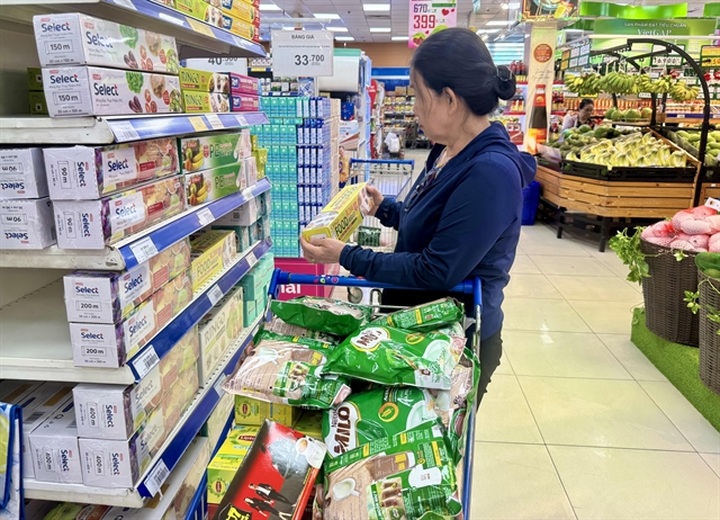
Across supermarkets and traditional markets in Ho Chi Minh City, shoppers are becoming more cautious, focusing on basic items and discounted products.
Nguyen Thanh Kien, a resident of Tan My Ward, said food prices have risen noticeably in recent weeks.
“Prices have clearly gone up. Vegetables like Malabar spinach and water spinach cost a few thousand dong more per bunch, while meat, fish and eggs are no longer at pre-Lunar New Year holiday levels,” she said.
“We have to tighten spending, cut back on snacks and only buy essentials. I now cook at home and bring meals to work.”
The shift is also evident among market vendors. A seafood seller at Phuoc Long Market said customers are buying less and opting for cheaper products.
“People used to buy ten items, now it is seven or eight. Instead of large prawns, they choose smaller ones. Big prawns now sell mainly for special occasions,” the vendor said.
Higher input costs have forced many food outlets to raise prices. On Pham Huu Lau Street, several breakfast stalls reported declining customer numbers after price increases.
“With rising ingredient costs, we had no choice but to raise prices, and that immediately affected sales,” a pho vendor said, adding that customers now order fewer items.
Nguyen Thi Toan, a resident of Tan Thuan Ward, said her family has adjusted its habits. Relying on eating out, they now spend an extra VND 20,000-30,000 per meal (about USD 0.8-1.2), prompting a shift to simpler meals or home cooking.
Retailers are also bracing for weaker demand. Phan Minh Tam, purchasing director at WinCommerce, said about 80 per cent of suppliers have requested price increases.
“When prices rise too much, consumers prioritise essential goods. Retailers must be very cautious in managing prices,” he said.
Meanwhile, major chains are trying to absorb part of the cost increases. Nguyen Thi Bich Van, communications director at Central Retail Vietnam, said the company is working to keep prices stable despite higher transport and input costs.
“We have maintained promotions and stable pricing thanks to early stockpiling, while continuing to negotiate with suppliers,” she said.
Retailers warn that unchecked price rises could further weaken demand. A representative of AEON Vietnam suggested expanding the list of price-stabilised goods and called for a reduction in VAT to ease pressure on consumers.
Nguyen Nguyen Phuong, deputy director of the municipal Department of Industry and Trade, said rising production costs are affecting the entire supply chain.
“Price increases directly impact purchasing power and disrupt goods circulation. However, they also create opportunities for stronger businesses with stable production capacity to remain competitive,” he said.
Authorities are encouraging retailers to prioritise cost-efficient suppliers and participate in price stabilisation programmes, while the Ministry of Industry and Trade has urged businesses to keep prices steady to maintain market balance.


