General Secretary and State President To Lam has signed Resolution 09 issued by the Politburo on the construction and development of Ho Chi Minh City in a “new era”.
Under the resolution, Ho Chi Minh City is envisioned as a symbol of Vietnam’s dynamic development, serving as the country’s main growth engine, innovation hub and a key centre for international integration.
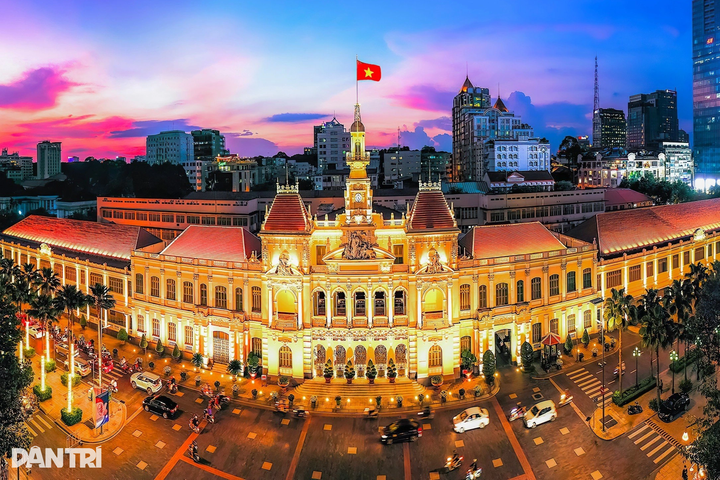
Ho Chi Minh City People's Committee headquarters (Photo: Hai Long).
The Politburo set a goal for the city to become a modern, civilised, dynamic and innovative metropolis by 2030, with a prominent position in Southeast Asia.
By 2045, the resolution said Ho Chi Minh City should become a major Asian centre for economics, culture, society, science, technology and innovation, as well as an attractive global destination.
Looking ahead to 2075, marking 100 years since the reunification of Vietnam, the city is expected to become a smart global metropolis comparable with the world’s leading urban centres.
The resolution targets annual GRDP growth of at least 10 per cent during the 2026-2030 period, with per capita GRDP reaching a minimum of USD 14,000 by 2030.
The digital economy is expected to account for around 40 per cent of the city’s GRDP by that time. Authorities also aim to complete about 200km of urban railway lines while largely resolving issues related to flooding, environmental pollution, traffic congestion and illegal drugs.
During the 2031-2035 period, the city is expected to maintain annual GRDP growth of at least 10 per cent, with per capita GRDP reaching at least USD 25,000 and the digital economy contributing around 60 per cent of output.
For the 2036-2045 period, Ho Chi Minh City aims to sustain annual GRDP growth above 10 per cent and achieve per capita GRDP of at least USD 75,000 by 2045. By then, the city is also expected to complete its urban railway network and achieve net-zero emissions.
Between 2046 and 2075, the Politburo targets minimum annual GRDP growth of 6 per cent, with per capita GRDP rising to at least USD 100,000 by 2075.
To achieve these objectives, the Politburo called for a new growth model centred on science, technology, innovation, digital transformation, labour productivity and competitiveness.
The resolution also outlined plans for Ho Chi Minh City to develop regional and international financial and logistics centres while becoming a major service hub specialising in high-end and modern industries.
Among the key proposals is the drafting of a Special Urban Law aimed at creating an exceptional institutional framework and legal system for the city. The Politburo described the initiative as a “breakthrough of breakthroughs” intended to maximise Ho Chi Minh City’s potential and mobilise resources for rapid and sustainable growth.
The resolution also stressed the need for long-term urban planning strategies capable of adapting to climate change.