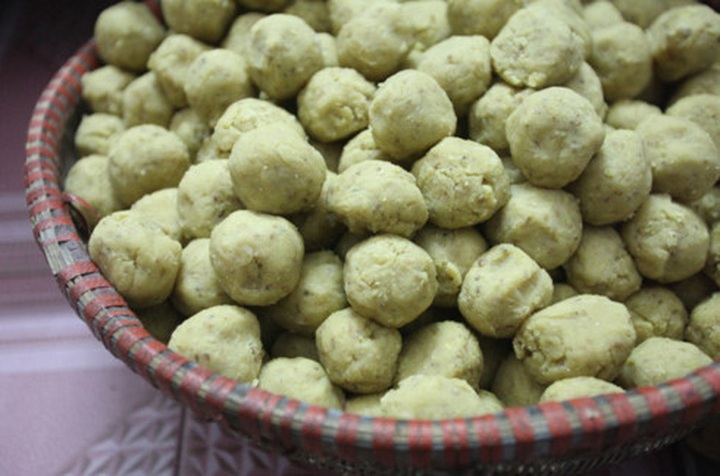
The cake has the aroma of glutinous rice blended with green beans, meat, and spices.
Making a white “chubby” cake involves many steps. The glutinous rice is soaked overnight, then steamed, ground, and shaped into flat, round patties. Green dong leaves must be washed and dried. The next steps are to make the filling and shape it into small balls.
Nguyen Thi Tuat, a Thuong Dinh cake maker, said, “Selecting the rice and green beans is the most important step, which should be ‘Nep cai hoa vang’, a kind of large-grain glutinous rice from Hai Hau district in Nam Dinh province. The green beans should be the small kind from Thanh Hoa. After being soaked for about 2 hours, both the rice and green beans are steamed.”
Making Giay cakes is tedious. The villagers must stay up late at night and wake up early while the profit is not much. As the expiry date is short, less than 24 hours, in the winter locals start at 9 p.m. the previous day and in the summer at 1 or 2 a.m. so the cakes will be ready for sale in the morning.
Thuong Dinh villagers mainly produce Giay cakes to order for weddings, festivals, restaurants, and hotels.
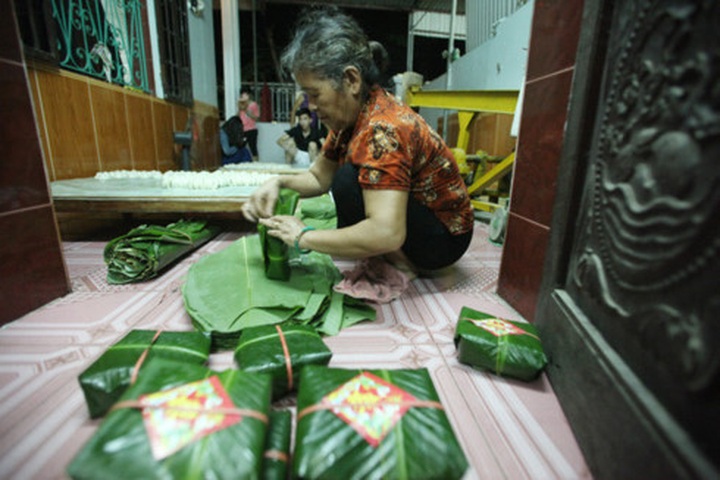
According to experienced villagers, 1kg of glutinous rice and half a kilo of green beans produces 2kg of cakes – about 20 cakes. Tuat said that during the Hung Kings’ death anniversary in 2002, Thuong Dinh villagers set a record for Vietnam’s biggest cake to offer to the founders of the Vietnamese nation.
“In 2002, we made a huge vegetarian Giay cake to offer to the Hung Kings on their death anniversary. All the villagers were mobilized to help make the cake, which weighed 1.8 tons made from 1.3 tons of rice. It set a record for the biggest Giay cake in Vietnam. The village festival falls on the seventh day of the second lunar month every year. On that day, we prepare Giay cakes to worship our ancestors,” said Tuat.
For hundreds of years, Giay cakes have been considered an indispensable part of Vietnamese cuisine and a symbol of Hanoi’s culinary culture.