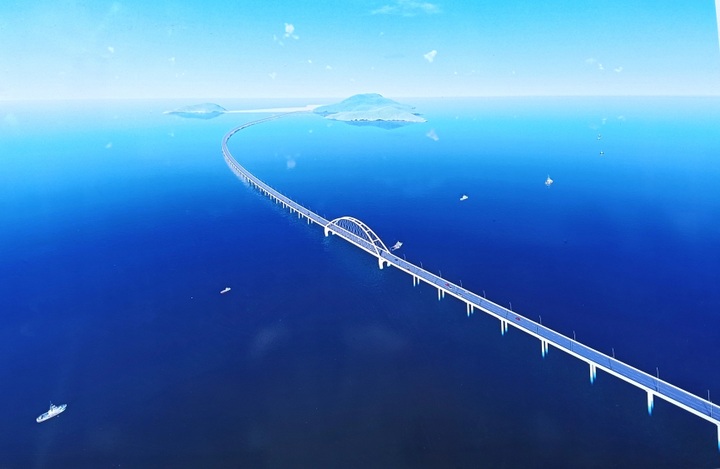
The project, together with the Ca Mau-Dat Mui expressway, is encountering difficulties securing key construction materials, according to the contractor under the Ministry of National Defence.
Ca Mau province has virtually no local sources of construction sand and stone, while demand for materials for the projects is extremely high. Landfill sand alone is estimated at about 26 million cubic metres, with concrete sand at around 2.1 million cubic metres. Other materials include about 1.5 million cubic metres of aggregate stone, roughly 4 million cubic metres of cement concrete stone and about 0.6 million cubic metres for asphalt concrete.
To supplement supply, several nearby provinces have granted or are processing licences for mining. Can Tho has approved the extraction of about 17.2 million cubic metres of sea sand, while Vinh Long has authorised exploration for roughly 2 million cubic metres. Dong Thap is seeking approval to explore four mines with estimated reserves of around 2 million cubic metres, and An Giang authorities are reviewing a licence for a mine with reserves of about 0.93 million cubic metres.
However, the contractor said procedures for mineral exploration and mining permits can take around six and a half months under current regulations, potentially affecting the supply schedule. In addition, some sea sand mines that have already been licensed cannot currently operate because rough sea conditions prevent extraction and transport.
Domestic commercial sand sources are also limited, forcing contractors to import additional sand from Cambodia, although supply volumes and delivery schedules remain unstable.
Meanwhile, site clearance work for the projects has largely kept pace with the schedule. For the Ca Mau-Cai Nuoc and Cai Nuoc-Dat Mui expressway sections, land clearance has been separated into an independent project managed by the Ca Mau provincial government with a total budget of more than VND 2 trillion (about USD 78.6 million) from the state budget.
The expressway corridor requires clearance of more than 700 hectares of land, and the local authorities have mostly handed over the main route to contractors.
For the road and bridge project linking to Hon Khoai Island, the total area of land and water required is about 234 hectares, including roughly 34 hectares of state-managed forest land. Authorities have already handed over the onshore auxiliary construction area, though about 3 hectares remain pending a plan to recover forest vegetation.
According to the contractor, the Hon Khoai road and sea bridge project presents major technical challenges as it is the first time the unit has constructed an offshore bridge of about 18km in length under complex geological conditions.
The Ca Mau-Cai Nuoc expressway section stretches 42km with a total investment of more than VND 28.1 trillion (about USD 1.1 billion), with construction progress reaching about 4 per cent. The Cai Nuoc-Dat Mui section is nearly 40km long with an investment of more than VND 29.7 trillion (about USD 1.17 billion), and has completed more than 6 per cent of the work.
Meanwhile, the road and sea bridge project to Hon Khoai island spans more than 18km with a total investment exceeding VND 25.7 trillion (about USD 1.01 billion). Contractors have begun drilling piles both onshore and offshore, while the value of materials mobilised, component production and construction has reached more than VND 407 billion (about USD 16 million), equivalent to nearly 2 per cent of the construction contract value.
The contractor has urged local authorities to prioritise licensing for sand and stone mines in order to ease material shortages affecting the projects.