Two experts have given comments on the USD6 billion project for the expansion of the entire National Highway 1A, with one warning that such a project may cause a huge waste, while another is concerned about its feasibility.
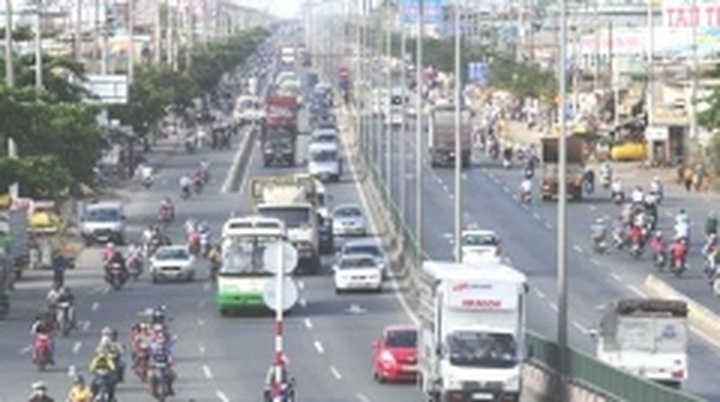 |
| A section of National Highway 1A in HCMC's Binh Tan District - Photo: Tuoi Tre |
The existing highway runs through crowded urban areas where congestion is already prevalent due to large amounts of traffic of various kinds of vehicles, he said.
“Can the expanded highway resolve such congestion? – It cannot, since the expansion project has yet to include uniform urban re-arrangement solutions that serve the expansion. And regarding the solutions that have already been drafted, it will be very hard to remove millions of people whose livelihoods are closely related to the road,” he explained.
Such an expansion, expected to be finished in 2016, means an “enlargement” of everything that is in place, and then some time later, under the effects of population growth, everything will return to its current state, he said.
“Meanwhile, the North-South expressway, which has been designed to run 1,800 km from Hanoi to Can Tho with 4-8 lanes, should be seen as the country’s backbone route, as it will not run through urban areas crowded with traffic and residents.
“The expressway is expected to be completed in 2020, and by then expanded National Highway 1A will actually become a sub route by which vehicles enter urban areas from the expressway.
“Imagine the co-existence of the expressway and the expanded highway at that time and you can find such an expansion as a redundant and wasteful project.”
In terms of investment mobilization and capital return, the expansion of the highway will face the same difficulties as the building of the expressway, since both of them are large projects.
Therefore, investment capital should be intended for the expressway rather than the highway. However, the expansion of a few sections of the highway to improve traffic is still a good idea, he said.
Feasibility a must
Dr Nguyen Ngoc Long, standing deputy chairman of the Vietnam Bridge and Road Association, is concerned about the feasibility of the planned expansion.
After 20 years of operation with some upgrades made, the highway has become overloaded and needs to be expanded, but the issue is that such an expansion must be feasible, firstly in mobilizing investment capital, then in organising and carrying out site clearance and compensation, Long said.
The expansion project should be based on sufficient scientific grounds and should not be developed only because of the pressure of overload, he said.
Previous upgrades to the highway took place after the US lifted the embargo on Vietnam, enabling the country to receive soft foreign loans to build its infrastructure. In addition, the population density along the highways was still low. Meanwhile, such soft loans are now difficult to obtain as they are provided on more difficult conditions related to feasibility, management and contractors.
On the other hand, it is necessary to have an assessment on the expansion of the highway in the past to form a basis for the building of the expansion.
In addition to seeking capital, site clearance and compensation are also crucial issues that must be considered and resolved satisfactorily, he said.
If all the above issues cannot be solved, the project cannot be completed within 4 years, during which investment capital is not enough and social security is not ensured, he warned.
As earlier reported, the Prime Minister has asked the Transport Ministry to develop the expansion and complete it in late 2016, with an estimated total investment of USD6.07 billion, of which Build-Operation-Transfer (BOT) investors will cover most of the investment, while about USD985 million of the amount will come from the State budget, government bond revenue, and the auction of fee collection rights.