Farmers are not directly benefiting from the government’s rice purchase policy
While the government still has to spend a certain amount of money to subsidise interest rates for rice exporters who buy rice, yet such businesses continue to complain about losses.
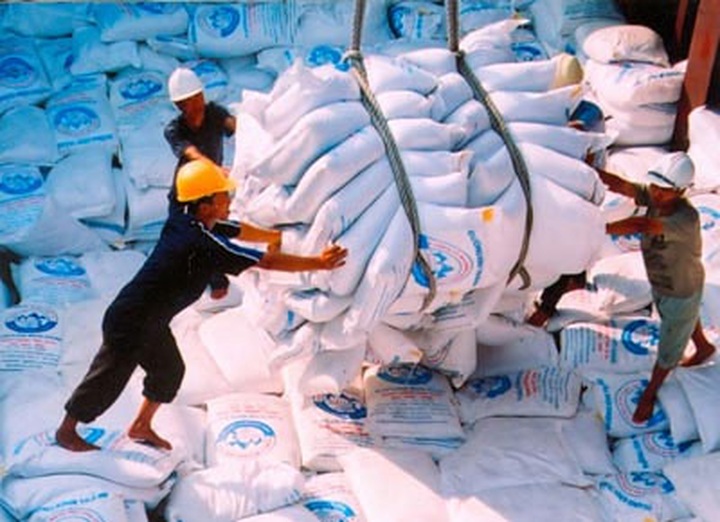
Upon the request from the government, the Ministry of Agriculture and Rural Development (MARD) in coordination with the State Bank of Vietnam (SBV), the Ministry of Finance (MoF) and the Ministry of Industry and Trade bought one million tonnes of rice from the 2012-2013 winter-spring crop in the Mekong Delta region from February 20 to March 31, 2013.
The bought rice is for temporary reserve for three months from February 20 through May 20 for export. The government subsidised all the interest on the loans used for the rice purchases.
The SBV assigned 13 commercial banks to take part in lending for the programme at a maximum interest rate of 11% per year.
According to the SBV’s report, at the end of the rice purchase deadline, commercial banks had lent out VND7.612 trillion (USD363.42 million).
The MoF estimated that with the average rice production costs for the crop at VND3,616 (USD172.45), the disparity between the production cost and the sold prices ranged from 38%-46%. However, farmers did not benefit from all the profits which were said to be distributed to wholesalers and exporters.
The allocation of quotas of rice for the programme has yet to meet the demand of several localities as the amount of bought rice just accounted for 15% of rice for sale.
Truong Thanh Phong, Chairman of the Vietnam Food Association (VFA) cited several localities that the policy was inadequate as it started late compared to the harvest in some places and the benefits for rice growers were too modest.
“VFA have collected ideas from such localities and have been seeking approval from the government to allow some localities to take over the rice purchases instead of exporters as currently. If they do it well, the best interests of farmers would be ensured,” Phong noted.
Phong said that 79.1% of farmers in the Mekong Delta region sell fresh rice right after the harvest, so there’s no reason for enterprises not to buy rice then.
During the time of rice purchase for temporary reserve, if one enterprise is assigned to buy 100,000 tonnes of rice, they even buy up to 500,000 tonnes at high prices. Due to decreased export rice prices, exporters incur a USD35 loss per tonnes of rice bought under such programme, he said.
It is estimated that with the VND7.612 trillion outstanding loans for rice purchases under the programme at an interest rate of 11% per year for three months, the amount of money spent by the government to subsidise the interest rates is just equal to the price disparity from rice purchases during peak harvest season.
This means that such policy is more of an administrative intervention into the market. Both farmers and exports gain little from it despite the government’s spending.
In order to ensure real and long-term benefits for rice growers, experts all emphasised the necessity to make more practical and efficient measures to support farmers directly.
“The government has assigned MARD to preside over a meeting in May to discuss a new solution to better support farmers,” Phong noted.
Dr. Pham Dong Quang, Deputy Director of the MARD’s Department of Cultivation, emphasised the necessity to work out a long-term solution in order to increase productivity and quality as well as lower production costs by minimising the use of pesticides and fertilizer.
He added that the department would coordinate with ministries and branches to compile a circular to guide the use of rice farmland so as to diversify crops in such areas.