A stretch of wave-breaking embankment and seaside walkway in Cua Tung Commune, Quang Tri Province has been heavily eroded, with the damaged section located close to the entrance of the nationally significant Vinh Moc Tunnels complex.
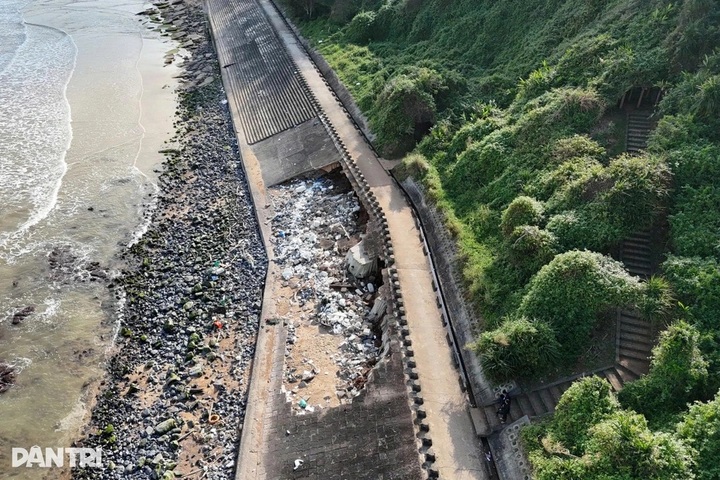
About 60 metres of the seawall have been battered by waves, leaving parts of the structure hollowed out and forming large cavities. Sections of concrete and protective structures have also been dislodged and pushed towards the water’s edge.
A concrete coastal road runs above the damaged section and is frequently used by residents and tourists. With the base of the seawall eroded, parts of the road now appear unstable and could collapse without timely reinforcement.

Local residents said the erosion has persisted for several months. The affected area has become a hazardous low-lying spot where waves deposit rubbish such as plastic bags, bottles, branches and even animal carcasses.
Officials from the site’s management board warned that the erosion could spread and potentially threaten the historic tunnels, which lie only about 10 metres from the damaged section.
Phan Truong Dinh, head of the site’s management board, said the seawall had been weakened after the impact of Typhoon Bualoi in 2025, with repeated heavy rain and strong waves hitting the structure.
“The erosion point lies within the core protection zone of the heritage site. If it is not repaired soon, the upcoming storm season could directly threaten the tunnels,” he said.
According to Vo Duc Dien, chairman of the Cua Tung Commune People’s Committee, local authorities inspected the site after receiving reports from residents and the heritage management board.
The provincial government has allocated VND 1.5 billion (about USD 57,034) for urgent repairs, with reinforcement work expected to begin later this month.
The Vinh Moc Tunnels were built between 1965 and 1967 inside a basalt hill near the coast, covering about seven hectares. The underground system stretches 1,701 metres and includes 13 entrances, seven of which face the sea.
The tunnels have three interconnected levels: the upper levels were used as living quarters and administrative areas during wartime, while the deepest level served as storage for food and weapons.
The tunnels, along with the broader Vinh Linh underground village system, were recognised as a national special relic site in 2014.