Before dawn broke, the tidal flats of Quynh Phu Commune in Nghe An Province were already bustling with activity. Carrying rakes and baskets, hundreds of workers waded in lines across the vast sandy expanse revealed by the receding tide. For clam harvesters, another day of physically demanding work, and modest rewards, had begun.
Across the commune’s more than 300 hectare tidal zone, dozens of households rely on clam farming for their livelihoods, a trade entirely governed by the rhythm of the tides. To catch the narrow working window, many residents wake at 3 am or 4 am, setting out before first light and often labouring until after midday before seawater floods the flats again.

Dozens of households in Quynh Phu Commune have long relied on clam farming across more than 300 hectares of coastal tidal flats (Photo: Nguyen Phe).
Scattered across the sands are makeshift huts used not only to guard farming plots but also to monitor salinity and water conditions daily. For local families, clam farms represent far more than income, they are often among their most valuable assets.
To Thanh Bien, 65, from Son Hai in Quynh Phu Commune, has worked in clam farming for more than five years and understands the trade’s uncertainty well. His family currently manages over 3 hectares of clam beds.
Unlike many aquaculture industries, clam farming requires no feeding, but success depends heavily on stable environmental conditions.
“Just prolonged heavy rain or unusual changes in water sources can seriously affect the entire farming area,” Bien said.
He recalled years when severe floods pushed freshwater from upstream into coastal waters, causing mass clam deaths or sweeping entire stocks away overnight. In favourable seasons, however, each hectare can generate profits worth several hundred million dong.
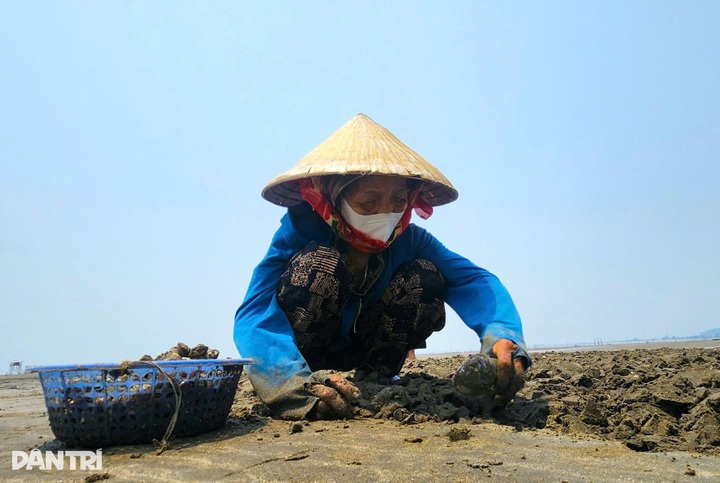
Despite being 75, Ho Thi Chat still goes out to the tidal flats every day to work for hire and earn a living (Photo: Nguyen Phe).
In 2025, Bien’s family suffered significant losses due to flooding. Entering the new season, he hopes each hectare will yield 8 to 9 tonnes of clams. At current market prices of around VND 22,000 (approximately USD 0.85) per kilogramme, good weather conditions could bring in hundreds of millions of dong in revenue.
The clam industry not only supports farming households but also provides seasonal jobs for many local workers. At the start of each season, farm owners hire labourers to spread juvenile clams and level the tidal flats. During harvest periods, workers return to rake clams for additional income.
Nguyen Thi Ly, 67, said labourers are paid based on output. On average, a worker can collect between 80 and 100 kilogrammes of clams a day, earning around VND 200,000-250,000 (approximately USD 7.70-9.60).
“The work is not too physically demanding, but you spend hours standing in seawater under the sun. Only people who are used to it can stay with the job,” Ly said.
At 75, Ho Thi Chat still travels daily to the tidal flats for hired work. Under the harsh sunlight, the elderly woman skillfully turns over layers of sand with her rake searching for clams.
“In this job, you always have to watch the tides. Some days the water rises quickly while we are still working, and everyone has to gather their things and rush back to shore,” Chat said.
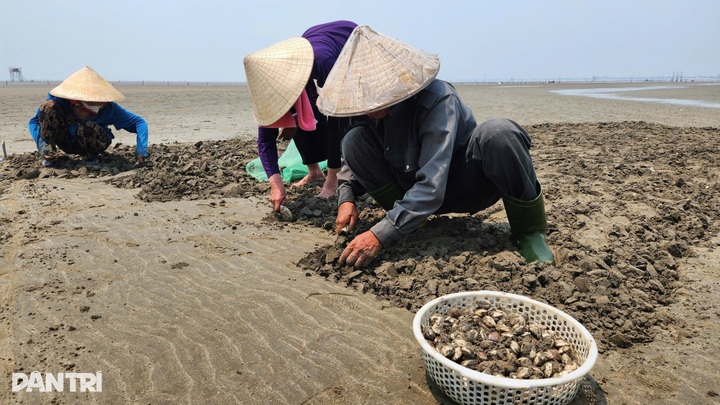
Clam farming provides a stable source of income, helping many coastal households improve their living standards and develop their family economy (Photo: Nguyen Phe).
According to Cao Xuan Diep, vice chairman of the Quynh Phu Commune People’s Committee, clam farming has long been a crucial source of income for coastal residents.
“It not only brings stable earnings for farm owners but also creates regular employment for local labourers, from seeding and maintenance to harvesting. Thanks to clam farming, many households can support their daily lives and strengthen their family economy,” Diep said.