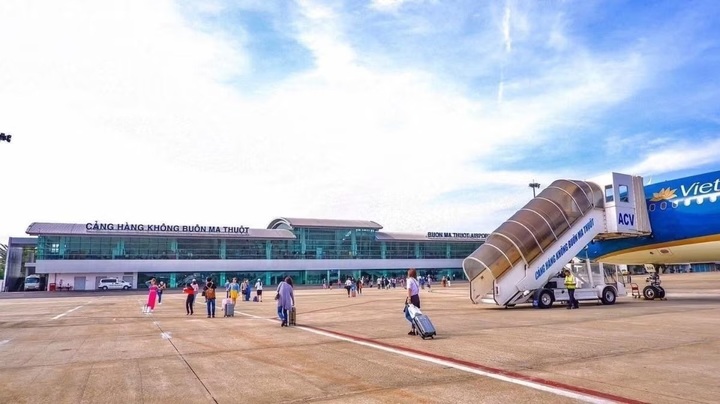
The Civil Aviation Authority of Vietnam (ACV) has submitted a proposal to the Ministry of Construction seeking approval for the development plan of Buon Ma Thuot Airport for the 2021-2030 period, with a vision to 2050.
According to the authority, the total investment needed for the project is estimated at nearly VND 20 trillion (approximately USD 770 million).
Under the proposed plan, during the 2021-2030 phase, Buon Ma Thuot Airport will remain a domestic airport serving both civil and military purposes and retain its 4C classification.
This phase will require nearly VND 11 trillion (approximately USD 423 million) to upgrade infrastructure comprehensively.
For passenger terminals, the airport will continue operating the existing Terminal 1, which has a capacity of two million passengers per year, while a new Terminal 2 will be built with capacity for three million passengers annually.
Total airport capacity during this phase is expected to reach between three million and five million passengers, along with 10,000 tonnes of cargo per year.
A 13,100-square-metre cargo terminal area will also be built to the east of the passenger terminal.
Looking ahead to 2050, the airport will require an additional VND 9.018 trillion (approximately USD 347 million) for further expansion.
The airport will maintain its 4C classification but increase capacity to seven million passengers and 15,000 tonnes of cargo annually.
To meet this demand, Terminal 2 will be expanded to handle 5 million passengers per year, while a second 2,400-metre runway will be added 275 metres north of the existing runway.
An independent general aviation terminal will also be developed during this stage.
To support the full master plan, the airport will require more than 518 hectares of land, which will remain unchanged from 2030 to 2050.
Buon Ma Thuot Airport is one of only three airports in the Central Highlands region. It currently serves as a grade one military airport and a national civil airport with 4C classification.
The airport is located on one of Vietnam’s most important aviation corridors, connecting Hanoi and Ho Chi Minh City, while also providing convenient air links to major tourism centres such as Danang, Vinh, Thanh Hoa, Haiphong and Quang Nam.
However, the airport has seen rapid growth in recent years, with many core facilities becoming overloaded and actual passenger volumes far exceeding earlier forecasts.