Discovery deep in the forest
The newly-discovered cave in Phong Nha - Ke Bang National Park has been named Thang Cave, or Victory Cave in English, after Nguyen Quyet Thang, a 36-year-old resident of Phong Nha Commune, who first identified its entrance.

Nguyen Quyet Thang, who discovered the location of the new cave in Phong Nha - Ke Bang National Park (Photo: Tien Thanh).
An avid cave explorer, Thang has regularly assisted expedition teams surveying the vast cave systems of the UNESCO-listed national park.
He first came across the cave in 2023 but paid little attention to it at the time.
During another expedition on February 7, 2026, Thang returned to the site and became intrigued by a powerful stream of air flowing from a small entrance measuring only about five square metres.
"I approached the entrance but could not get inside because it was almost vertical. Access required ropes and specialist equipment. From the strong airflow, I suspected it was a deep and extensive cave, so I reported the discovery to the expedition team," Thang said.
Following his report, adventure tourism operator Jungle Boss worked with the management board of Phong Nha - Ke Bang National Park to organise a formal survey.
In early June, Thang joined a six-day expedition into the national park to explore the cave.
Initial mapping showed the cave stretches for about 3,000 metres with an average width of 70 metres, expanding to more than 100 metres in some sections. It has two entrances and splits into two separate branches. The main entrance covers around five square metres, while the exit is narrow enough for only one adult to squeeze through.
To reach the cave floor, explorers descended approximately 20 metres using ropes. They were greeted by a vast underground chamber filled with spectacular limestone formations created over hundreds of thousands of years.
"What impressed me most was the enormous scale of the cave and its magnificent stalactites and stalagmites in countless shapes and colours. There are also remarkable clusters of cave pearls that look like chicken eggs," Thang said.

Thang Cave, recently surveyed, lies within Phong Nha - Ke Bang National Park in Quang Tri Province (Photo: Jungle Boss).
The discovery further highlights the outstanding universal value of Phong Nha - Ke Bang National Park and opens new opportunities for scientific research, conservation and adventure tourism.
With its striking geological features, Thang Cave is expected to become a major new attraction for visitors exploring Vietnam's cave systems.
"I never imagined that a cave would one day be named after me. It is an incredible honour and a very special feeling that is difficult to put into words," Thang said.
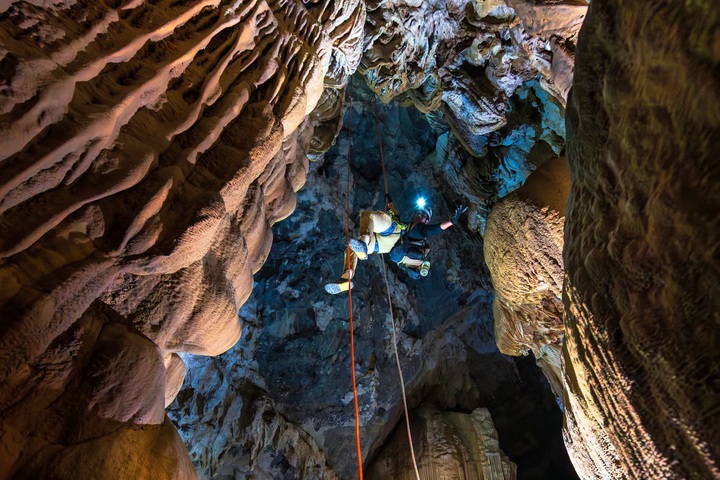
To reach the floor of Thang Cave, the expedition team had to abseil about 20 metres down (Photo: Jungle Boss).
Thang currently helps his family run their business, but the discovery has inspired him to become more involved in cave exploration, conservation and sustainable tourism.
He hopes that once the cave is opened to visitors, he will have the opportunity to work there full time.
"It makes me proud to have contributed, even in a small way, to discovering and promoting the natural treasures of our country. I hope this beautiful cave will become a fascinating destination for visitors in the future," he said.
Jungle Boss has pledged to employ Thang as a safety assistant. He will receive professional training in expedition techniques, rescue procedures and adventure tourism operations, giving him the opportunity to build a long-term career in the sector.
According to the management board of Phong Nha - Ke Bang National Park, more than 30 years of exploration and research have identified seven major cave regions within the park's limestone massif, including the Phong Nha, Vom and Nuoc Mooc cave systems.
More than 470 caves have now been recorded in the park, with a combined surveyed length exceeding 250 kilometres, making it one of the world's most extensive and diverse karst cave landscapes.