By Dr. Tung Bui, Faculty Director of Vietnam Executive MBA, University of Hawaii
The year 2014 has been so far a great start for most of the world’s real estate markets. As 2013 was a great year for the stock markets, many investors are cashing in profits and moving some of their funds to real estate. Sell high, buy low, as one would say it.
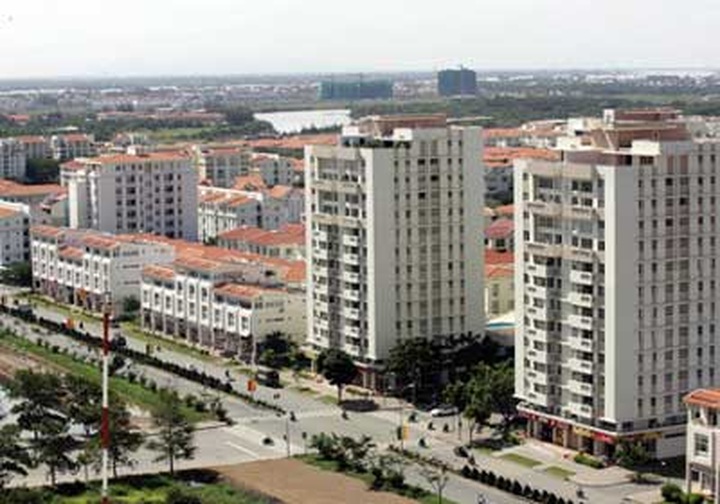
Illustrative photo. Apartment buildings in Hanoi
Most notably, foreign investments in the real estate market have been just astounding. Chinese investors made the headline this morning in Australia as they spent almost $US.5.5 billion in Australia’s real estate market last year. According to ABC News in Australia, about 12% of new homes in Australia were bought by Chinese nationals in 2013. Credit Suisse reports that Chinese purchased 18% and 14% of new homes in Sydney and Melbourne respectively. Facing slower growth forecasts at home, and thanks to the new government policy called “Go Global”, Chinese are now in a shopping spree looking for real estate investment worldwide. The Swiss bank estimates that the Chinese spent USD22 billion on Australian property over the past seven years, and they are likely to pour in $US40 billion more in the residential real estate over the next 7 years.
Chinese are not alone. With abundant liquidity, many foreigners are looking for real estate markets that show high return potential. Singaporeans poured dollars in the UK, with London as the top country for real estate investing. Greeks in Germany. Hong Kong nationals in Canada. Canadians in the USA. Etc.
But all eyes seem to focus on the U.S. market. The five most popular countries for foreign real estate investment are the USA, Australia, UK, Canada and Germany. At the PERE (Private Equity Real Estate) summit in Hong Kong this week, the US is seen by professional investors as the likely top spot for foreign real estate investment. This is primarily thanks to investors’ perception that the American market is transparent, efficient, and has the highest potential for price appreciation. According to HFF research, the US is poised to get the largest market share of an estimated amount of $180 billion in 2014 by Chinese insurance firms alone. Many of them are interested in retail and hotels, and residential land development.
The overall economic impacts for a country that can attract foreign investments, such as Australia and the USA, should be positive. Of course, it is all smile for local real estate developers, building suppliers and tax authorities. The Property Council of Australia argues that international investment in real estate was crucial to the country national growth. And the government should focus on improving ways to ensure fast supply of real estate. New construction will create more jobs. It also presents timely opportunities for urban planning that meets the lifestyle of the 21st century. Last but not least, it is also beneficial to the retail industry. Colliers International’s analysts claim that overseas investment during the last six months in property has helped propelled the Australian retail industry with an annually adjusted growth of 9.4%.
But foreign real estate acquisition likely hurts first-time local home buyers. Local middle-class homebuyers will not be able to compete against foreign investors with deep pockets. In addition, some local lawmakers have expressed concerns that the national regulations and existing infrastructure are not ready yet for a flood of foreign ownerships. Perhaps there is here a lesson learned from Singapore’s Central Provident Fund. Started by the British colonial authority in 1955, the law requires working citizens and their employers to establish a savings plan to fund their retirement and housing needs. In parallel, the government uses tax revenues to build public housing. With the Provident fund and affordable housing, Singapore is among the top countries in the world with 90.5% of home ownership.
Vietnam’s real estate market has shown some tentative sign of recovery, according to Jones Lang LaSalle, a global real estate consultancy company. With one of the world’s worst market performances in real estate since 2009, there are scores of local cash-trapped investors who went out of business or on the verge of bankruptcy. Since Vietnam’s real estate is a buyer’s market, it is important for the authorities to develop policies to reduce investors’ perceived risks. Last week, at the 26th National Assembly session, the Ministry of Construction and the National Assembly’s Economics committee were working on a Housing bill to reduce restrictions for Viet Kieu to buy property. This is certainly a positive step but apparently not competitive and not swift enough. Even with the ability to extend the lease beyond the legal limits of 50-year lease, foreign investors do have a choice to invest elsewhere with less financial and economic risks, fewer language, social and cultural barriers. As Stephen Wyatt of Jones Lang LaSalle puts it, a single measure alone will not be sufficient. If Vietnam is to join the world’s real estate market, it should do whatever it can to revive the residential and commercial real estate markets. Chinese or not. Viet Kieu or not. Single foreign investor or multinational investment funds. The sooner Vietnam is able to compete with the international property investment market, the better for the local cash-trapped property investors looking for cash-abundant buyers, and in the long run, better for the national economy.