Ho Chi Minh City is assessing the feasibility study for the proposed Thu Thiem-Long Thanh Metro project, a major rail link intended to connect the city centre with Long Thanh International Airport.
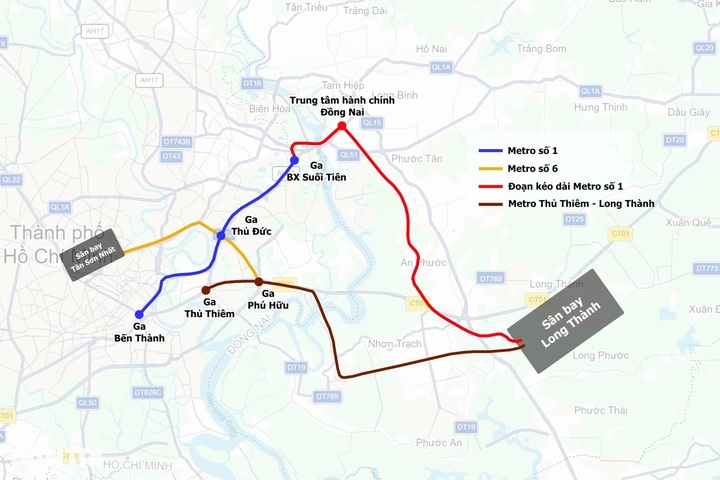
Route of the Thu Thiem-Long Thanh Metro line (Graphic: Ngoc Tan).
The project is being studied under a build-transfer (BT) contract model, with project documentation prepared by Dai Quang Minh Real Estate Investment JSC.
According to the proposal, the metro line will stretch 46.44km, including 34.54km of elevated track and 11.01km of underground sections. The route will begin at Thu Thiem Station in Ho Chi Minh City and run to Long Thanh International Airport and the Cam Duong Depot in Dong Nai City.
The section within Ho Chi Minh City will be 11.24km long, passing through Binh Trung and Long Truong Wards. The remaining 35.2km will run through Dong Nai City, crossing Nhon Trach and Long Thanh wards, as well as Long Phuoc, Xuan Que and Xuan Duong communes.
The line is planned as a mass rapid transit (MRT) system featuring double tracks, a standard-gauge rail width of 1,435mm and full electrification. It will include 18 stations.
Electric multiple unit (EMU) trains on the route will have a design speed of 120km/h on elevated sections and 90km/h in tunnels. Operating speeds are expected to reach 110km/h and 80km/h respectively.
During the initial phase, trains will consist of three carriages with a capacity of 1,012 passengers. The system has been designed to allow expansion to six-carriage trains in the longer term, increasing capacity to 2,072 passengers.
The project is expected to use GoA4 automation technology, the highest level of train automation, allowing fully driverless operations. Trains will receive power through an overhead rail system, while the network will incorporate multiple forms of automatic fare collection.
Under transport planning proposals, the Thu Thiem-Long Thanh Metro will serve as a key rail corridor linking Long Thanh International Airport with central Ho Chi Minh City. Its technical standards are intended to be fully compatible with the city's Metro Line 2 network, including the Ben Thanh-Tham Luong and Ben Thanh-Thu Thiem sections.
A consortium comprising China Railway Liuyuan Group and Hung Nghiep has recently been selected to review the project's feasibility study.
Ho Chi Minh City aims to begin construction around the National Day holiday on September 2 and complete the line by 2030.