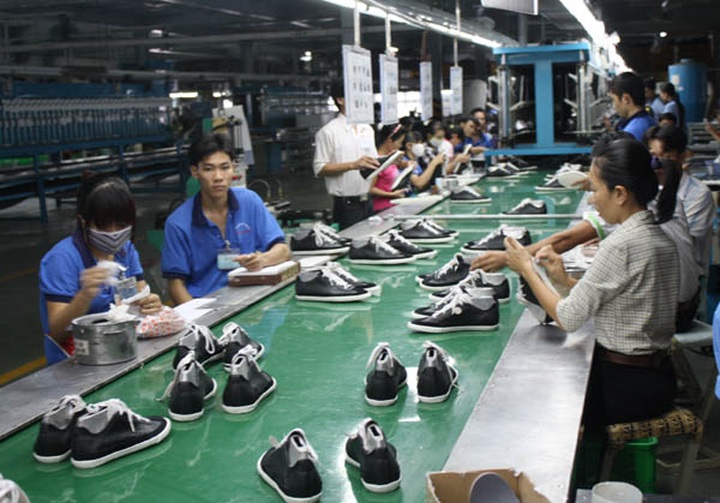
Workers at a footwear company in Binh Duong Province
The seminar, titled "EU's new regulations on GSP – opportunities for Vietnamese businesses," informed participants of the new rules and their potential impacts on Vietnam.
In his opening remarks, Dr. Franz Jessen, Ambassador and Head of the EU Delegation to Vietnam, said: "The strong growth of Vietnamese exports to the EU market is partially attributed to some Vietnamese products enjoying the GSP treatment."
He said that around 49 per cent of Vietnam's exports of footwear have benefited from preferential tariffs under the GSP regime.
From 2014 onwards, more Vietnamese products, including footwear, can gain further benefits from the new GSP regulations, he said.
The EU officially published its amended GSP regulations last October, saying they aimed to facilitate market access for goods originating from developing countries, including Vietnam.
The new regulations will take effect early next year.
Vietnam will remain in the list of countries eligible to enjoy the EU's GSP treatment with an enlarged number of favoured tariff lines.
Nevertheless, the new "graduation" rules may expose a number of Vietnam's key exports to the risk of ineligibility, the seminar heard.
The GSP is the result of inter-governmental negotiations held under the auspices of the Conference of Trade and Development of the United Nations.
The scheme offers import tax preferences for goods from least and developing countries exported to GSP host countries on a unilateral basis (not reciprocal).
GSP tariffs are lower than those levied under the Most Favoured Nation (MFN) status, and can be reduced to zero per cent, depending on the regulations of the host country.
"Thanks to GSP provided by the EU, many Vietnamese products have been able to compete in these markets, especially textiles and garment, footwear, seafood and handicrafts, thus rapidly increasing Vietnam's exports to this market," former Trade Minister Truong Dinh Tuyen said at the seminar.
In order to take advantage of the new GSP rules, Tuyen advised businesses to understand well the GSP regulations of each host country (rule of origin, competition, transportation etc) so as to avoid obstacles and potential losses.
They should further improve product quality, diversify product portfolios, and reduce production costs and prices in order to enhance the competitiveness of Vietnamese products, he said.
Vietnamese firms should also expand and further diversify their export markets, avoiding dependence on just one market, he added.
Industry associations, especially those who have a large proportion of their products exported to the EU, should disseminate timely information to their members on emerging difficulties, and work closely with their members in adopting measures necessary to maximise the performance of each business and the industry, Tuyen said.
He said local businesses should also be aware that in many host countries, the list of products and tariffs under the GSP are not fixed but adjusted periodically, thus affecting the firms' ability to penetrate the market as well as production in exporting countries.
EU-Vietnam bilateral trade totaled US$29 billion last year, a year-on-year increase of nearly 20 per cent; and accounting for 12.7 per cent of the country's total import-export turnover.
Last year, Vietnamese exports to the EU amounted to $20.3 billion, a 22.7 per cent increase over 2011, accounting for 17.7 per cent of the country's total export value. The EU is Vietnam's second largest export market to date, Tuyen said.