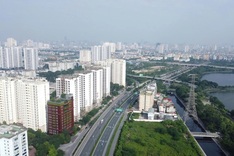
The development of an urban railway system has been considered an useful solution to help ease Hanoi's traffic, but various problems have slowed the pace.
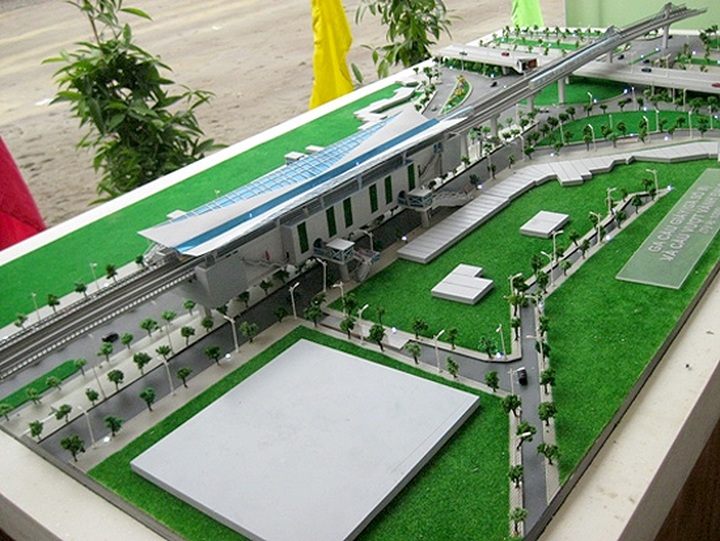
Hanoi plans to build eight urban rail projects included in its transport development plan by 2020 under the capital city’s master plan by 2030 with a version to 2050.
In an interview with DTiNews, Toshio Nagase, Senior Representative of Japan International Cooperation Agency (JICA) in Vietnam, said that the revocation of land that had already been granted for site clearance is among the biggest difficulties facing railway projects in Hanoi.
JICA has just completed the technical design for urban railway route No.1 (Giap Bat-Gia Lam). The site clearance of the area near Long Bien Bridge poses difficulties because Hanoi plans to build a second Long Bien Bridge about 30 metres away from the current one. The railway will run on the new bridge to the opposite side of the river. He hoped that it could be complete by 2017.
He added that, each urban railway project has a different donor, so to manage projects in a co-ordinated way has also been a large concern.
Tran Van Luc, Director of the Railway Project Management Unit under the Vietnam Railway Corporation, said that site clearance for a path to a particular station along route No. 2A (Cat Linh-Ha Dong) is lagging behind schedule. It was supposed to be finished by June. He urged the People’s Committee of Ha Dong District to finish the work by August this year.
Route No. 3 (Nhon-Hanoi Station), slated to be finished in 2016, also faces risks of running behind schedule due to shortage of capital.
Nguyen Van Doanh, Deputy Head of the Vietnam Railway Administration, admitted that there were some outstanding problems with urban railway projects, including lack of management expertise and the implementation of related technological and EPC contracts.
According to Toshio Nagase, JICA is willing to lend its support to the city in carrying out routes No. 1 (Giap Bat-Gia Lam) and No. 2 (Nam Thang Long-Tran Hung Dao), which have received Japanese ODA. They have co-operated with the Ministry of Transport and Hanoi People’s Committee to create a feasibility study on the construction of urban railway route No. 5, which would link the southern part of West Lake to Ba Vi District under a public-private partnership.
JICA is also assisting HCM City’s Japanese-funded urban railway project No. 1 (Ben Thanh-Suoi Tien). JICA is studying to help Hanoi and HCM City to set up a company specialising in the operation, management and maintenance of urban railway routes.
When asked about the North-South high-speed railway, the JICA official said that they are in continuous co-operation with Vietnamese agencies to do feasibility study, but to date nothing specific has been decided.
He suggested prioritising the construction of key sections, as opposed to trying to build the entire route system at once.