The government has sent a report on disaster prevention and control in the central region to the National Assembly.

Consecutive storms in Vietnam leave 235 dead and missing.
According to the report signed by Deputy Prime Minister Trinh Dinh Dung, since early October, up to five storms have lashed central and southern central localities, triggering historic torrential rains in many areas.
Storm Molave has been seen as the biggest storm to hit the central region of Vietnam over the past two decades, bringing rainfall of up to more than 3,000 mm.
On October 12-19, around 317,000 households with a total 1.2 million people faced severe floods. Many localities were put under water for 15 days. Quang Binh Province was hardest-hit with 109,000 households submerged.
Prolonged and heavy rains resulted in serious landslides, including at Rao Trang Hydropower Plant in Thua Thien-Hue Province, Phuoc Son and Nam Tra My districts in Quang Nam Province and Huong Hoa District in Quang Tri Province.
The government report indicated that as of now, at least 235 people have died or been listed as missing following the floods and landslides due to storms and heavy rains in central Vietnam last month.
The natural disasters have also damaged 201,000 houses in central and southern central localities. The consecutive storms have led to total losses of around VND17 trillion (USD733.4 million), including VND10 trillion by Storm Molave.
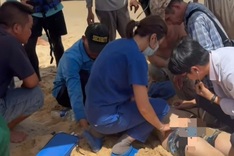
Under the government’s instructions, concerned agencies need to mobilise all forces and equipment to find missing victims, including those of landslides at Rao Trang 3 Hydro-power Plant construction site in Thua Thien-Hue, in Quang Nam’s Nam Tra My and Phuoc Son districts and fishermen of Binh Dinh’s two fishing vessels, while requesting safety for search and rescue forces.
The government also emphasised the importance of relief activities to help flood-hit victims so that they can stabilise their lives.
Ministries, agencies and localities will focus on repairing works damaged by floods, especially the power supply system, transport, dykes, schools and hospitals.