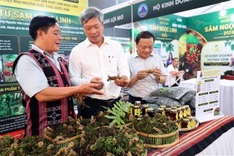
DAA's vice chairman Nguyen Hoang Anh
The seminar was jointly held by the board for private economic development research (IV Board) and the Digital Agriculture Association (DAA).Nguyen Hoang Anh, DAA's vice chairman, said due to closeness, China has been the major customers for Vietnamese farm produce. Last year, Vietnam exported USD3.5bn of farm produce, of which 76% was to China. However, there are still many shortcomings with export procedures.
Most of the produce is being exported by unofficial cross-border trade without much care about brand name development or point of origin. Fruits are sometimes stuck at the border or unable to find outlets, leading to sharp drops in prices and dumping of produce. Anh hoped firms would invest more in China by improving their processing and competitiveness to develop stronger brands.
"We hope associations, experts and export firms will work together to boost the quality of Vietnamese agricultural products. Related agencies should propose solutions to support the firms and expand markets," he said.
Wen Xi Chen, Economic and Commercial Counselor at the Chinese Consulate General in Ho Chi Minh City, said China had imported more agricultural products to meet rising demand and become the world's largest importer of agricultural products with its imports making up 10% of global trade in farm produce.
In November, an international fair will be held in Shanghai and as a close partner of China, there was an opportunity for Vietnam to boost its products at the fair. Firms should take notice of Chinese consumer habits.
Chen agreed that border trade is not stable and poses huge risks as there are mostly small and micro firms trading via border gates. The small scale of business also means uneven quality and weak competitiveness. Vietnamese firms need to be more proactive. Chinese traders have to go to Vietnam to find and order the products they want.
According to Chen, the authorities should monitor market trends, find the most effective managing policies for the agriculture sector and contact with Chinese customs offices to deal with possible exporting problems.
Financial institutions are urged to provide more support while manufacturers are asked to apply more technology.