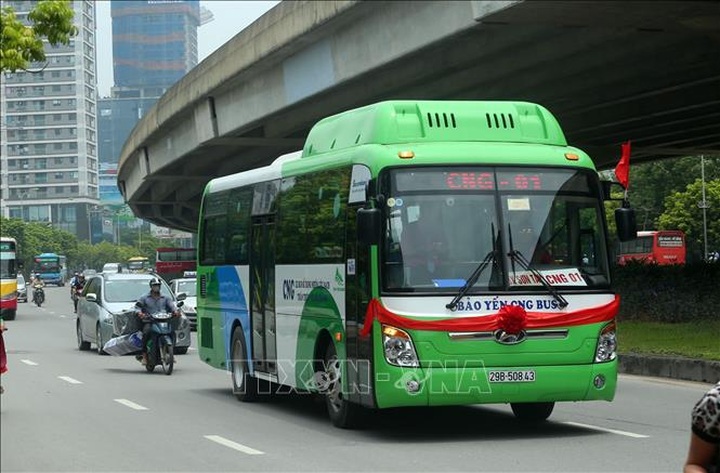
A public bus in Hanoi. Photo by VNA
Speaking at the workshop, director of the Hanoi Urban Transport Management and Operation Centre, Nguyen Hoang Hai, said that public buses now only served 12% of travel demand, which was very slow growth compared to 10% five years ago.
"At this growth we'll not be able to reach the target of 20% people using public buses by 2020," Hai confirmed.
The official explained that one of the biggest challenges affecting the development of public buses was the fast growth of app-based taxi services with competitive prices.
"Another reason is the poor infrastructure which leads to a shortage of bus-stops and a lack of separate lanes for buses," Hai added. "Public buses have also become slower, at an average speed of 20 kilometres per hour, due to bad road quality and rising traffic jams."
According to Hai, public buses saw a passenger growth rate of just below 1% in the first half of this year compared to 2018.
Deputy general director of the Hanoi Transport Corporation (Transerco), Nguyen Cong Nhat expressed concerns that if there is no urgent solution to improve the infrastructure, people will turn away from public buses due to their inconvenience.
Agreeing with the representative from Transerco, a lecturer at the Hanoi Transport University, Nguyen Ngoc Quang, added that time is one of the most important factors that decided the choice of means of transport for passengers, especially office workers.
"Now students and elderly people are the biggest bus users," Quang said. "We can also attract a large number of office workers if we can improve the bus speed. Fares don’t mean much to this group."