
 |
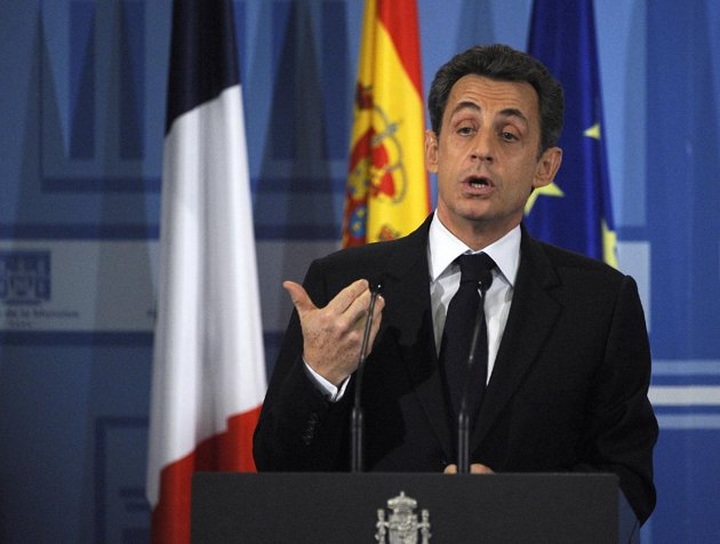
| France's President Nicolas Sarkozy gives a press conference with Spain's Prime Minister Mariano Rajoy at the Moncloa Palace in Madrid. |
Sarkozy, the first foreign leader to meet with Spain's new conservative Prime Minister Mariano Rajoy, said the eurozone must improve competitiveness to boost growth as well as simply slashing spending.
"We are confronted by an unprecedented crisis that forces us to cut spending, lower our deficits but also to find the path to new growth by resolving our competitiveness problems," Sarkozy said.
The French leader warned against panic after Standard & Poor's Friday cut the credit rating of nine nations, stripping France of its top-notch AAA rating, slicing Spain's and Italy's ratings by two notches, but sparing Germany.
Moody's Investors Service soothed some of the pain Monday, confirming France's AAA rating while reviewing its "stable" outlook.
"Fundamentally it changes nothing," said Sarkozy, who was visiting Madrid to be honoured by King Juan Carlos for his help in fighting armed Basque separatists ETA.Draghi on Monday downplayed the importance of ratings agencies in comments at the European Parliament in Strasbourg.
"I think what we should do is to learn either to do without them or with them but to a much more limited way than we do today," he said.
Indeed, there seemed little sign of concern on financial markets, where news of the downgrades had already been telegraphed on Friday.
London's FTSE index of leading shares gained 0.37 percent to close at 5,657.44 points; Paris's CAC-40 index advanced 0.89 percent to 3,225 points; and Frankfurt's DAX 30 jumped 1.23 percent to 6,220.01 points.
The euro was unchanged at $1.2677.
"We have to reduce our deficits, cut spending, improve our countries' competitiveness to rediscover growth," Sarkozy said, urging people not to panic about the downgrades.
Paris was further buoyed when it successfully sold 8.59 billion euros in short-term bonds paying a lower rate of interest than at a previous similar auction despite the loss of its top-line rating.
Spain's leader, holding his first news conference since he took power, tried to play down the credit rating cut.
"In the end, the most decisive thing is that each country follow its own path," Rajoy said at a joint news conference.
The Spanish leader gave his support to a French-backed scheme to impose a tax on financial transactions, dubbed a "Robin Hood tax" or "Tobin tax," after Nobel Prize-winning economist James Tobin.
"Spain will support this tax," Rajoy said, describing it as Sarkozy's "war horse" to help beat the crisis.
The new right-leaning Spanish government has announced 8.9 billion euros in budget cuts, tax increases to bring in 6.28 billion euros and an anti-tax fraud battle to recoup another 8.17 billion euros.
Draghi nevertheless told European lawmakers: "We are in a very grave state of affairs and we must not shy away from this fact."
A top IMF official warned earlier that the eurozone faces a "downward spiral" if it fails to get its governance in order.
"Europe could be swept into a downward spiral of collapsing confidence, stagnant growth, and fewer jobs," IMF First Deputy Managing Director David Lipton warned Asian finance chiefs meeting in Hong Kong.
"In today's interconnected global economy, no country and no region would be immune from that catastrophe."
European leaders are due to meet on January 30 to discuss a new fiscal pact to coordinate deficit reduction programmes and attempt to reassure the bond markets that they are on top of the sovereign debt crisis.
But Sarkozy said talks planned for Friday between the leaders of France, Germany and Italy were being postponed until February because they had been in contact recently anyway.
"We stand together, the road ahead is clear: less spending, less deficits, more growth and competitiveness," said Sarkozy, who is facing an uphill battle for re-election in April.
Stalled talks between private lenders and debt-wracked Greece have raised fears, however.
Greece promised to resolve its disagreements with creditor banks to allow for an orderly "haircut" on its debt, rather than running the risk of a "hard default" that would surely trigger market panic.
"The discussions which are ongoing have I think helped us to reach a point, which is close to an agreement, but some further reflection is necessary on how to put all the elements together," Prime Minister Lucas Papademos told CNBC.
S&P on Monday downgraded the European Financial Stability Facility (EFSF) by one notch to AA+ in line with its downgrades of France and Austria as it uses guarantees from top-rated eurozone members to raise funds on the market to lend to troubled countries.
With debate already raging over increasing the bailout fund, Germany has opposed increasing its contribution, and its Finance Minister Wolfgang Schaeuble said Monday it had sufficient funds for the coming months.
However Draghi said if the eurozone wanted to EFSF to continue to enjoy low borrowing costs and have the same lending capacity "you have to have additional contributions from triple-A countries."
The EFSF, which started off with a borrowing power of 440 billion euros, has 250 billion euros left following rescues of Portugal and Ireland.


