The Japanese government said on December 15, 2025, that the assistance would help affected provinces respond to urgent needs and support early recovery efforts following recent natural disasters.

Ito Naoki, Ambassador of Japan, together with his spouse Silvia Danailov, the UNICEF Representative, visit Kim Cuc Primary School in Cao Bang province to examine water, sanitation and hygiene activities (Photo: nld.com.vn)
The aid will be delivered through the International Organisation for Migration (IOM) and the United Nations Children’s Fund (UNICEF) to help communities recover from a series of tropical depressions, storms and floods that struck Vietnam in 2025.
Under the package, USD 1 million will be allocated to IOM to provide non-food relief items to more than 32,000 people, equip 20 local search-and-rescue teams with essential rescue equipment, and directly support around 4,000 vulnerable residents.
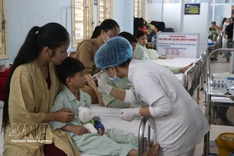
The remaining USD 500,000 will be channelled through UNICEF to improve access to clean water, sanitation and hygiene, repair sanitation facilities and upgrade school lighting systems, benefiting about 20,000 people, including 14,000 children.
Japanese Ambassador to Vietnam Ito Naoki said the assistance was intended to reach affected communities quickly, ease the impact of natural disasters and support recovery efforts. He added that Japan would continue technical cooperation through the Japan International Cooperation Agency (JICA), particularly in water management and infrastructure development in Vietnam’s central region which was hard hit by subsequent floods and storms.
In 2025, Vietnam was hit by 15 typhoons and floods, causing estimated losses of USD 3.6 billion. Typhoon Kalmaegi alone forced more than 500,000 people to evacuate temporarily. As of late November, 409 people were reported dead or missing, more than 337,000 homes were destroyed or damaged, and around 1.9 million people in nine provinces still lacked access to clean water and safe sanitation.
UNICEF Representative in Vietnam Silvia Danailov noted that children are among those most affected by climate-related disasters. “With Japan’s support, we can deliver essential services, reduce disease risks and help communities strengthen their resilience,” she said.
Kendra Rinas, Chief of Mission at the IOM Vietnam, highlighted Japan’s contribution to improving disaster response capacity, saying IOM would provide home repair kits, non-food items and rescue equipment for community rapid response teams.
Earlier in 2024, Japan supported Vietnam’s response to Typhoon Yagi, helping nearly 35,000 people in northern mountainous provinces gain access to clean water and child protection services. IOM also constructed six community shelters, providing safe accommodation for nearly 1,000 people in high-risk areas.
Both organisations reaffirmed their commitment to working closely with the Vietnamese government to support post-disaster reconstruction and strengthen preparedness for future climate risks.