Deputy Prime Minister Pham Gia Tuc, acting on behalf of the prime minister, has signed a decision approving the expansion of the Vung Ang Economic Zone in Ha Tinh Province. The provincial government confirmed the decision on October 2.
Under the decision, the expanded economic zone will cover about 72,998ha, comprising 57,998ha of land and 15,000ha of sea.
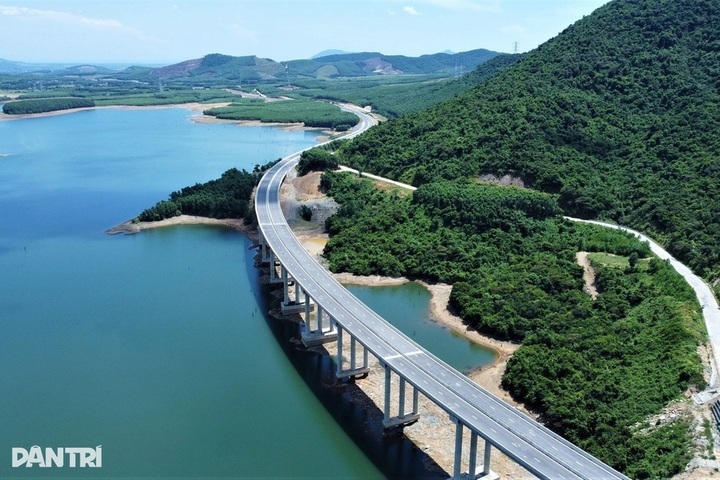
The Vung Ang - Bung expressway section passing through Ha Tinh Province (Photo: Duong Nguyen).
The land area will encompass the entire area of Song Tri, Hai Ninh, Vung Ang, Hoanh Son, Ky Hoa, Ky Khang, Ky Anh and Ky Xuan communes and wards, as well as part of Ky Van Commune.
Vung Ang is designated as a key, multi-sector economic zone, with basic industries centred on the development and efficient use of Vung Ang and Son Duong port complexes, as well as regional, national and international road and rail networks.
It is also intended to serve as an important economic, transport, trade and international exchange hub for the north-central region, providing a gateway from central and upper Laos and northeastern Thailand to central Vietnam and the wider country.
The economic zone is expected to become a growth pole closely linked to the development of Ha Tinh and the wider north-central region. It will also support and share development functions with the Southeast Nghe An Economic Zone, Hon La Economic Zone and surrounding areas.
The expansion is intended to create additional land and development space for future investment.
The government aims to develop Vung Ang into a dynamic economic hub of the north-central region and study new models, including a free-trade zone, to help drive socio-economic development in Ha Tinh and neighbouring areas.
The plan also calls for stronger links with economic zones, economic centres and development corridors across the region and along national and international transport routes.
The development strategy is built around metallurgy, energy, processing and manufacturing; logistics and seaport services; and trade and other services.
The zone is also planned to have modern, integrated infrastructure linked to deep-water ports, with high-quality logistics and transport, trade, information technology, tourism, education and healthcare services.
The government expects the zone to create jobs, strengthen vocational training and improve workforce quality. Investment will be selectively attracted, with priority given to projects using advanced technology, generating high added value, creating linkages and spillover effects, and aligning with regional and provincial development strategies.
During 2026-2027, authorities are expected to complete the master plan for the expanded economic zone and several 1:2,000 detailed zoning plans for key areas. The period will also see work begin on major infrastructure projects and efforts to attract domestic and foreign investment.
From 2028 to 2030, the zone is expected to begin efficiently operating completed projects while continuing to develop integrated urban, industrial and service infrastructure. Authorities will also seek investment in projects for the post-2030 period and study new industrial and manufacturing models.
From 2031 to 2050, the plan calls for completion of an integrated and modern economic and social infrastructure system across the economic zone.