
Greece revealed on Friday that it is 7.0 billion euros ($9.3 billion) short of a default-saving debt cut under a "historic" bond swap to avert bankruptcy and a new eurozone crisis.
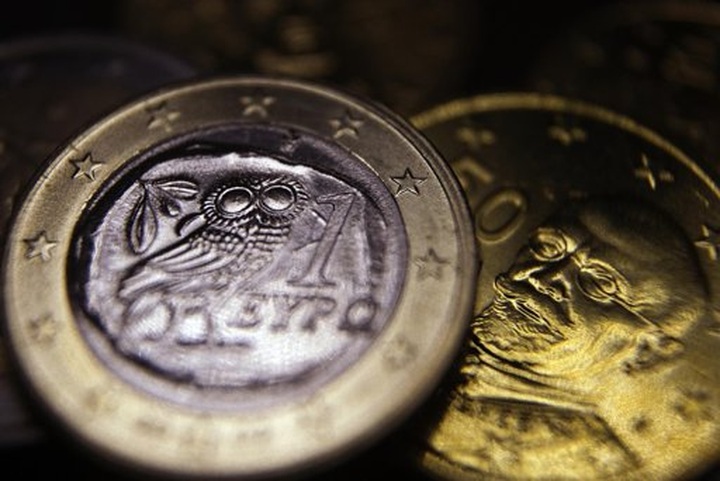 |
| Greece revealed that it is 7.0 billion euros ($9.3 billion) short of a default-saving debt cut under a "historic" bond swap to avert bankruptcy and a new eurozone crisis. (AFP Photo/Joel Saget) |
The announcement came shortly before official data showed that the Greek economy, in deep recession, has shrunk at a faster rate than thought.
The state statistics agency said the economy had contracted by 7.5 percent in the fourth quarter of 2011, revising a previous 7.0-percent estimate.
On an annual basis, this meant output shrank by 6.9 percent compared to a previous forecast of 5.5 percent.
The high level of acceptance of the swap terms is in line with a critical test for the EU and IMF to push on with a far bigger bailout for Greece, and Athens said it would now mop up remaining bonds affected by the exchange in the next two weeks.
"Seven billion euros remain in reality," Venizelos told a news conference, a few hours after the finance ministry said creditors had tendered bonds amounting to 83.5 percent of debt covered by a deal to cancel half the amount owed.
On the basis of full acceptance, Greece needs to secure a write-off worth 107 billion euros ($142 billion) to make its debt repayment sustainable.
Venizelos said all bonds issued under Greek law had been accounted for by virtue of legislation -- known as collective action clauses -- which now enable Greece to force compliance on all investors based on the majority decision to participate.
Holders of bonds issued under foreign law, and of bonds issued by state companies guaranteed by Greece, will be given until March 23 to decide, the minister said, warning that investors would be "naive" to expect a better offer.
EU Economics Affairs Commissioner Olli Rehn said on Friday: "I am very satisfied by the large positive turnout of the voluntary debt exchange in Greece". The result was a "decisive contribution to financial stability in the euro area as a whole."
Germany's finance ministry called the swap deal a "big step" towards stabilising the country and stressed that Greece had been handed a "historic chance". And France's Finance Minister Francois Baroin hailed the "good news" for Greece.
IMF head Christine Lagarde said that the "real risk of a crisis, of an acute crisis, has been, for the moment, removed."
The success of the debt swap is a vital step for Greece to be able to avoid a default as early as March 20 when it has to repay some debt. Default would be catastrophic for Greece and could cost the eurozone one trillion euros and send shockwaves around global financial markets.
It meets a central condition laid down by the European Union and International Monetary Fund for a far bigger overall bailout for Greece.
Eurozone finance ministers are to review the take-up figure for the swap in a conference call later on Friday.
Stocks in Tokyo closed at the highest level in seven months. European shares were mostly unchanged a day after sharp rallies on anticipation of the deal. The euro eased.
Greece's stock exchange have a limp response, opening with 0.93-percent gains but dropping to a loss of 1.19 percent in afternoon trade.
But the use by Greece of legal steps to force acceptance by recalcitrant bondholders could trigger anti-default insurance contracts, known as credit default swaps.
The International Swaps and Derivatives Association, an organisation representing more than 815 market institutions, is expected to determine later on Friday whether the Greek debt cut constitutes a credit event that would trigger the CDS instruments.
Venizelos said on Friday that the total value of credit default swaps was less than five billion euros, an "indifferent" sum.
Directors from the International Monetary Fund have tentatively planned to meet to weigh a new loan for Greece on March 15, spokesman Gerry Rice said on Thursday.
The EU and IMF have said that a participation rate of 95 percent is necessary to reduce Greek debt to a sustainable level of 120 percent of gross domestic product in 2020.
The writedown is the biggest attempted so far, overshadowing Argentina's $82-billion default in 2002, the equivalent of 73 billion euros at the time.
It is designed to erase more than 100 billion euros ($132 billion) from Greece's near and mid-term debt and replace it with new maturities.
The exercise is meant to ease the pressure on Greece from its debt mountain of currently more than 350 billion euros.
Failure to reach a deal would have increased the danger of a disorderly default which the IIF warned could cost eurozone nations one trillion euros.
This could have come as quickly as March 20, when Athens was due to reimburse a three-year bond worth 14.4 billion euros.