Speaking with reporters on the sidelines of the recent Vietnam Business Forum (VBF), Chairman of Vietnam Chamber of Commerce and Industry (VCCI) Vu Tien Loc said that Samsung Vietnam has around 200 suppliers of spare parts and accessories, but most of them are foreign businesses.
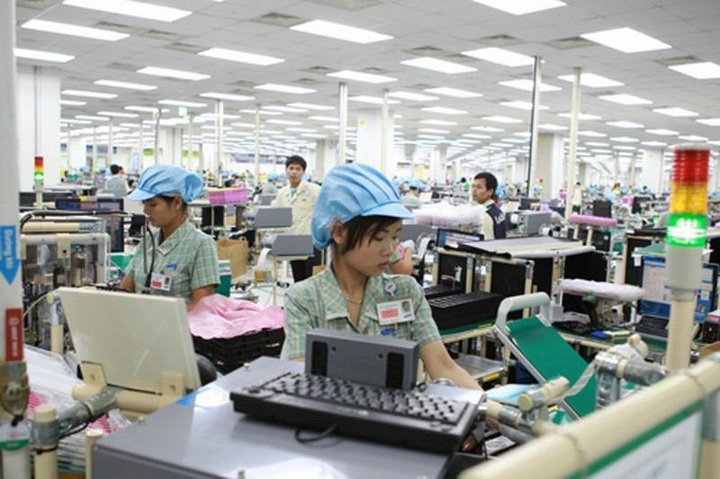
Samsung Vietnam has around 200 suppliers of spare parts and accessories, but most of them are foreign businesses
“This is both the bad and good news”, Loc said, specifying that Vietnam would benefit from a large influx of foreign investments; but domestic enterprises could be dominated by them if they failed to sharpen their competitiveness.
In the first half of this year, Samsung accounted for up to USD15 billion out of Vietnam’s total export value of USD54.3 billion. However, just a small number of local companies are able to be selected for Samsung’s production chain is a disadvantage.
It has been around 30 years since Vietnam’s economic reform was implemented, but until now, the country’s supporting industries have remained weak, giving the chance for foreign companies. So, how can Vietnam realise its modernisation dreams?
Le Thanh Thuy, Director of Tri Cuong Ltd. Co. in Hanoi, said that many Vietnamese companies couldn’t sell spare parts and accessories due to high prices. It was because they had to import materials for the production, which pushed up prices, Thuy noted.
For instance, in the garment and textile companies, many businesses have to import materials, which is the reason why their garment products are sold at high prices.
Up to around 30 sectors in Vietnam need supporting industries, but they have to import 80-85% materials from abroad.
Meanwhile, Vietnamese companies have failed to improve vocational skills and lack investment.
Nguyen Mai, chairman of Vietnam's Association of Foreign Invested Enterprises, cited the World Bank as saying that Vietnam is among countries which have the most policies for support industry development in the world, however, implementation is among the worst.
At present, 97% of Vietnamese companies are still small and medium sized-enterprises, so, how they can integrate into the global economy in the context of the fierce competition?