The unusual patches emerged after water levels receded around the fourth day of the lunar new year, or February 20. Photos of the colourful formations quickly spread on social media, drawing curious crowds to the site in Thanh Binh Commune.
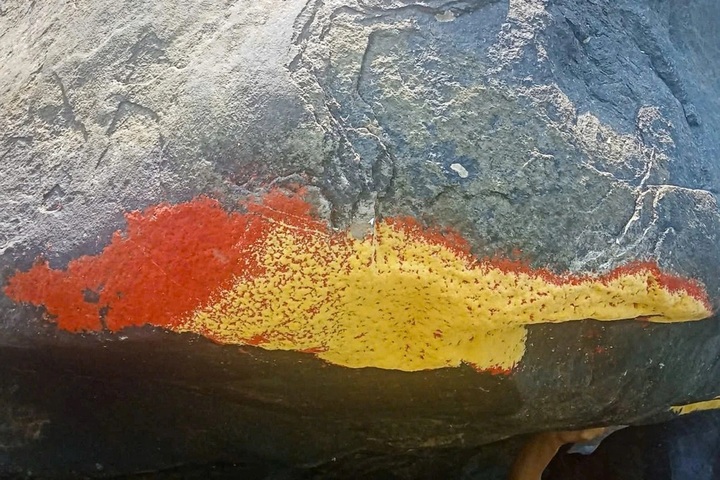
Despite heavy rain raising river levels on the morning of March 4 and making access difficult, a vivid red patch remained visible beneath the rock and did not wash away when splashed with water.
Nguyen Xuan Tien, 44, a resident of Son Cam Ha Commune, said he and several friends visited the area on March 2 and photographed yellow “blooms” stretching beneath the rock.
“The sight was surprising,” he said, noting the unusual colour and texture of the formations.
Local residents said the vibrant layer appeared suddenly beneath the rock. Images taken on February 27 showed at least two clusters of the spongy red formations.
The phenomenon does not occur every year and may appear only once every two to six years. A similar event was last observed in 2024.
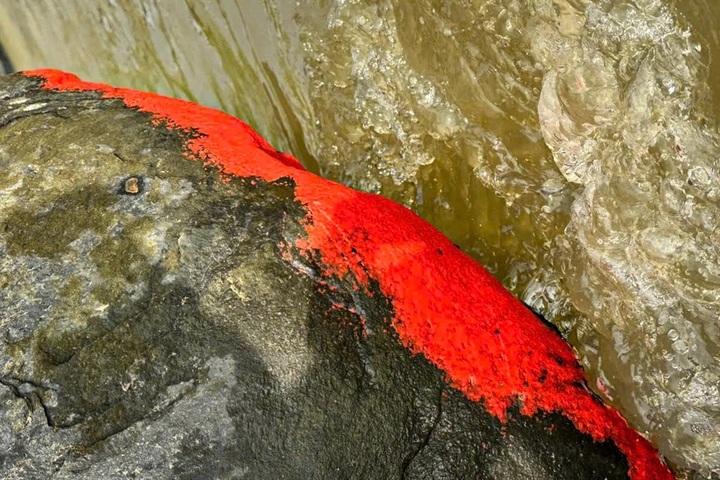
Duong Duc Lin, chairman of Thanh Binh Commune, said the phenomenon, locally described as a red streak or “blooming rock”, had appeared several times in the past and often attracted public attention.
Scientists who previously examined the site concluded that the formations are lichen growing on the rock rather than a rare geological event.
Lin added that local beliefs suggesting that years when the “rocks bloom” would bring prolonged heat were folk tales without scientific evidence.
Lichen is a complex life form formed through a symbiotic relationship between fungi and algae. It can grow on many surfaces, including trees, rocks, brick walls and even man-made objects such as wires and tyres.
Although common and often long-lived, many species of lichen are sensitive to sudden environmental changes and are widely used by scientists as indicators of air pollution.