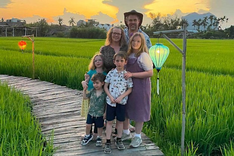
Dinh poses for a photo with a group of foreign tourists in Sapa
While guests set out to explore the surrounding villages, Sung Thi Dinh sits at her computer preparing the lunch menu at her homestay in Ta Van Mong village, Ta Van Commune, Lao Cai Province.
Turning point through learning English
Over the past four years, Dinh says her family’s life has changed dramatically.
“Our life has changed so quickly, almost like a dream,” she said. “Learning English gave me the motivation to overcome difficulties and build what we have today.”
Dinh was born into a poor Hmong family with four siblings in Ta Van Commune. Her parents continued doing hard manual work to support the family even as they grew older.
When she was 16 and in her first year of high school, Dinh attended a three-month English class in Sapa run by foreign volunteers. It was her first opportunity to study a foreign language in a structured way.
At first, learning English was extremely challenging because the volunteers taught entirely in English.
“At that time I knew almost nothing about the language. I couldn’t even understand basic greetings,” she recalled.
Despite the difficulties, Dinh remained determined, seeing the class as a valuable opportunity to prepare for the future. She once dreamed of becoming a teacher to help children in her village.
However, during her final year of high school she had to drop out due to illness and financial hardship.
Recognising that Sapa attracts large numbers of tourists, the 18-year-old decided to work as a trekking guide in the hope of earning income while improving her English.
“I learned English from tourists. On each trekking trip I treated them as teachers who helped me improve my pronunciation and expressions,” she said.

Dinh's homestay is always busy because the owner knows how to care for and understand the needs of each group.
A new direction after marriage
Dinh was pursuing a career as a professional guide when her life took a different turn after she got married.
In many families in the village, early marriage is still common. Because of her family’s financial difficulties, her parents also hoped she would settle down and gain more stability.
After marrying a man from the same village, the couple soon had a child and struggled financially due to unstable jobs. The pressure of supporting her family pushed Dinh to find ways to earn more money.

When the COVID-19 pandemic hit, tourism in Sapa almost came to a standstill. She tried selling various products online, from clothes to local agricultural goods, but the income was barely enough for daily expenses.
A turning point came after the pandemic, when tourism gradually recovered. Dinh was hired as a manager at a local homestay, an experience that proved crucial.
There she learned how to welcome guests, manage bookings and deal with operational issues. In the evenings she studied how to sell trekking tours online and practised communicating with foreign customers.
After a year of experience, she decided to start her own tourism business.
With initial capital of about VND 100 million (about USD 4,000), Dinh bought timber and built a small stilt house to open her own homestay.
At the beginning, the couple handled everything themselves. Her husband cleaned rooms and cooked for guests, while Dinh guided trekking tours. The meals served to visitors were the same traditional dishes the family ate every day.

Dinh and her husband's spacious homestay
Growing tourism business
Dinh believes attentive service is the key to attracting returning guests.
“I always try to understand what each guest needs and ask for feedback after every trip to improve our service,” she said.
Satisfied visitors often recommend the homestay to friends, helping the number of guests grow steadily.
Beyond introducing the natural beauty of the Sapa area, Dinh also aims to share the culture of ethnic communities such as the Hmong, Dao and Giay with international visitors.
In the evenings, guests can join cooking experiences such as making fried spring rools and other traditional Vietnamese dishes.
After five months of operation, Dinh reinvested more than VND 300 million (about USD 12,000) to expand the property. She upgraded the stilt house to include nine bedrooms and added several private bungalows.
Today the homestay has 16 rooms and can accommodate around 30-40 guests per day. During peak tourist seasons in Sapa, the rooms are often fully booked.
In November 2025 alone, the property welcomed about 2,000 domestic and international visitors, generating strong revenue.
The business has also created jobs for around 10 people in the village, who help with cooking, cleaning and guiding cultural experiences for tourists.
“Many women in the village used to have no stable jobs. When the homestay gets busy, I want everyone to join and earn extra income,” Dinh said.

The scenery around Dinh's homestay is picturesque (Photo: Supplied).
Looking back, she describes her journey as almost unbelievable. Once a young Hmong woman who could not speak English and struggled to buy essentials for her child, she now runs a successful tourism business and provides jobs for others in the community.
Hang A Sang, head of Ta Van Mong Village, confirmed that Dinh and her husband operate a homestay and organise local tours for visitors.
“This model helps improve the family’s economic situation and creates employment for several villagers,” he said.
Ta Van Mong Village currently has more than 18 households operating homestay accommodation, with tourism increasingly providing stable livelihoods for local residents.