The Heroic Vietnamese Mother Monument complex stands on Cam Mountain in Quang Phu Ward, Danang City, covering more than 16 hectares and inaugurated in 2015. The monument was selected from a sketch by artist Dinh Gia Thang and was designed based on the portrait of Nguyen Thi Thu, from Dien Thang Trung Ward, Danang City.
On January 16, 2007, the prime minister issued a decision placing the Heroic Vietnamese Mother Monument on the list of national cultural works.

The entire monument is assembled from solid granite blocks, with the combined weight of stone and concrete reaching about 20,000 tonnes. Its architecture resembles a mountain peak at the centre, sloping lower on both sides, evoking the idea that a mother is an endless source and the soul of the nation.
At the centre is an 18-metre-high bust of Thu. The monument's two wings curve outwards like arms opened wide to shelter her children, while the side walls faintly depict the figures of children gathered around their mother.
The monument is modelled on Nguyen Thi Thu, who lost nine sons, one son-in-law and two grandchildren in the wars against France and the United States.
On December 17, 1994, Nguyen Thi Thu was awarded the state's prestigious Heroic Vietnamese Mother title. She died on December 10, 2010, at the age of 106.

During commemorations and cultural events, the site often hosts incense-offering ceremonies in memory of fallen heroes and Heroic Vietnamese Mothers. In the picture is a wreath from Dantri/Dtinews Newspaper, the Vietnam Seas and Islands Association and Naval Region 3 Command, placed solemnly at the monument in tribute to Heroic Vietnamese Mothers and fallen heroes.
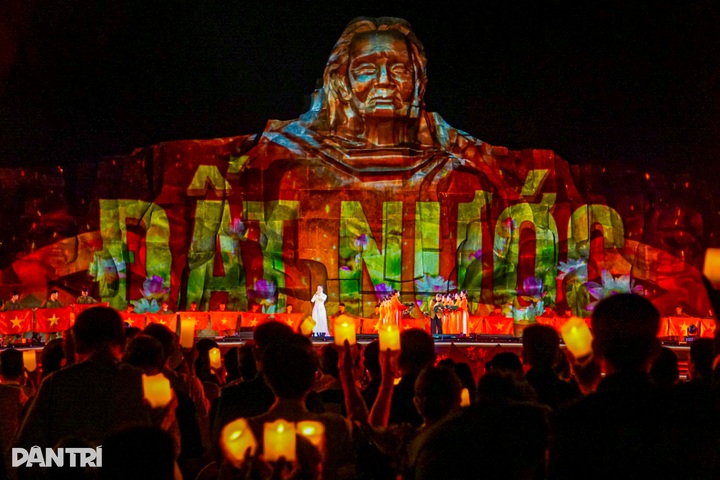
The site has also been chosen to host major national and city-level events. The image shows a memorial ceremony for fallen heroes in front of the monument. The words "dat nuoc" are projected on to it, as if the Heroic Vietnamese Mother were embracing the nation.

The architectural complex also includes eight legendary pillars in front of the entrance, each 11.2 metres high and made of granite. The eight pillars are carved with images of Heroic Vietnamese Mothers in tribute to their sacrifices.
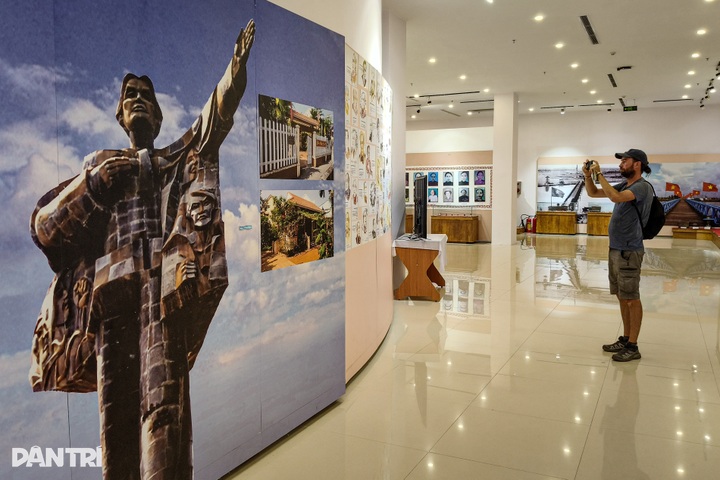
The monument is hollow, and inside it is a memorial house for Heroic Vietnamese Mothers, where the names of nearly 50,000 Heroic Vietnamese Mothers from across the country are recorded.

Visitors can view documentary photographs, biographies and artefacts linked to the lives and wartime contributions of Heroic Vietnamese Mothers.

Among the exhibits are a bronze pot used to cook rice for troops, a wartime weaving loom and a ceremonial flower vase, all vividly reflecting the mothers' quiet sacrifices and profound devotion. The image shows a scarf belonging to Heroic Vietnamese Mother Nguyen Thi Thu on display in the memorial house.

A letter from Le Ngoc Lan, sent from Quang Ninh Province, to Heroic Vietnamese Mother Trinh Thi Quy in Tam Thang Commune, Tam Ky City, former Quang Nam Province, on August 1, 1959, is preserved at the memorial house.

Visitors are told deeply moving stories of the quiet sacrifices made by Heroic Vietnamese Mothers.
The image shows a bronze statue of Heroic Vietnamese Mother Ngo Thi Luot, from Go Noi Commune, Danang City. During the war years, her home served as a revolutionary base sheltering many cadres and local guerrillas. She lost three relatives in the two wars. The bronze statue was donated to the management board in April 2017 by her daughter, Tran Thu Hong.

According to the People's Committee of Quang Phu Ward, the Heroic Vietnamese Mother Monument complex is a place of remembrance where people across the country come to honour the nation's steadfast sacrifices. The site helps educate younger generations about patriotism, national pride and Vietnam's enduring tradition of gratitude. The stories and artefacts in the memorial house offer vivid lessons in history, inspiring gratitude and national spirit among visitors, especially the young.

Beside the monument stands the Quang Nam Martyrs' Cemetery, the resting place of thousands of fallen heroes who fought and died for the nation's independence and freedom. The site carries deep historical and spiritual significance, embodying Vietnam's tradition of gratitude.