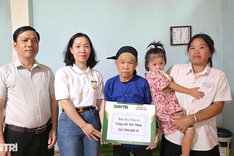
A reporter from Dantri Newspaper presented VND 174.9 million (USD 7,000) raised through its charity programme to Nguyen Nam Anh Van, 33, from Phuoc Hoi Ward, Lam Dong Province.
The full amount was transferred to the account of his sister, Nguyen Thi Diem Ngan, to ensure timely treatment.
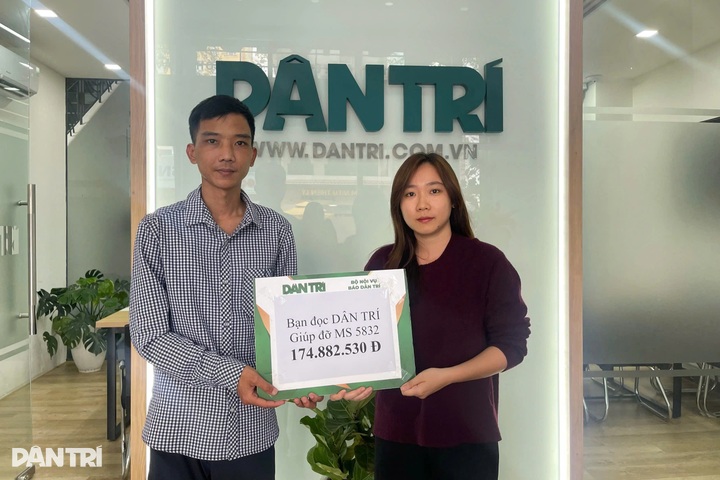
A Dantri reporter presents the symbolic plaque representing VND 174,882,530 donated by readers to Nguyen Nam Anh Van (Photo: T.H).
Doctors at Cho Ray Hospital in Ho Chi Minh City said Van was admitted on December 29, 2025 with severe acute kidney failure and serious haemolytic anaemia, requiring continuous dialysis to survive.
His condition deteriorated, prompting intubation and transfer to intensive care. He later developed acute pulmonary oedema and respiratory failure, requiring constant oxygen support.
Following specialised tests and multidisciplinary consultations, doctors suspected atypical haemolytic uraemic syndrome, aHUS, an extremely rare condition affecting about one in a million people. The disease can cause acute kidney failure, multi organ failure and poses a direct threat to life without prompt treatment.
No treatment for the condition is currently available in Vietnam, forcing doctors to import medication at high cost.
Ngan said Van lived with their elderly parents and was the family’s main provider. Despite worsening health, he avoided seeking care due to financial hardship until his condition became critical.

Nguyen Nam Anh Van gasping for air in his hospital bed on January 12, 2026 (Photo: Nguyen Vy).
After Dantri published his case on January 12, widespread public support followed. In addition to the VND 174.9 million raised through the newspaper, donors contributed directly to the family about VND 700 million (about USD 28,000) by January 16.
The family has used VND 600 million (about USD 24,000) to access specialised medication for the initial treatment phase.

At noon on January 12, as his condition became critical, Van required intubation to sustain life (Photo: Family provided).
Van has since been extubated, weaned off ventilatory support and returned home in a relatively stable condition, though he continues to require regular dialysis.
Bui Le Cuong, deputy head of haematology at Cho Ray Hospital, said Van began his first intensive treatment cycle on January 15. Early results show improvement, with haematological indicators recovering by about 80 per cent.
Blood parameters have improved rapidly following treatment, though kidney function will require more time to recover.
The intensive phase is expected to last four weeks, after which Van will move to maintenance therapy costing around VND 400 million (USD 16,000) per month.
Doctors and the family have appealed for continued support to sustain treatment and aid recovery. Maintenance therapy may last several months depending on the patient’s progress.