
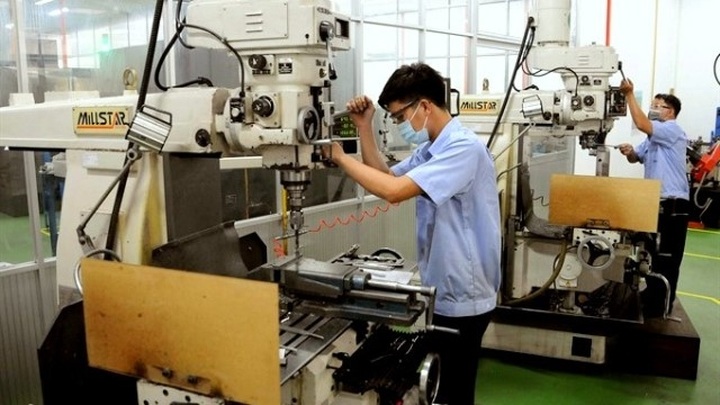
Workers process metal moulds at the SaiGon Industry Corporation in Ho Chi Minh City.
The strong export market in Vietnam is projected to help growth sustain itself, at slightly below 6.5% this year, according to the WB’s report.For Vietnam and the other countries in the Asia Pacific region, commodity import growth generally remains robust. Therefore, solid domestic demand, strong infrastructure spending and FDI-led investment in the manufacturing sectors and services will continue to benefit the country.
After a period of financial market volatility in late 2016, global finance conditions have improved in 2017. Although real credit growth has generally been moderated with tighter regulations and higher inflation, it has remained high in Vietnam and China.
The withdrawal of the US from the Trans Pacific Partnership (TPP), however, could potentially suppress significant growth opportunities for Vietnam. Changing trade policies would also affect certain economies in the Asia Pacific region, namely those with a sizable export market to developed economies, such as Vietnam, Cambodia, China, Malaysia and Thailand.
As manufacturing and trade pick up, market confidence rises, and commodity prices stabilise, advanced economies’ growth will accelerate to 1.9% in 2017, which will also be of benefit to the developed countries’ trading partners. Meanwhile, the growth rate of emerging markets and developing economies will increase to 4.1% this year from 3.5% in 2016.
“With a fragile but real recovery now underway, countries should seize this moment to undertake institutional and market reforms that can attract private investment to help sustain growth in the long term. Countries must also continue to invest in people and build resilience against overlapping challenges, including climate change, conflict, forced displacement, famine and disease,” said Jim Yong Kim, World Bank Group President.
In late March, the General Statistics Office of Vietnam announced that the country’s first quarter GDP growth was up only 5.1%, from the same period in 2016. This slow growth is attributed to the manufacturing sector’s underperformance. As such, the low percentage of this year’s first quarter growth poses a potential challenge to the National Assembly’s goal of a 6.7% GDP growth rate by the end of 2017.
Nonetheless, Vietnam Institute for Economic and Policy Research predicts that with a gradual increase in each quarter’s GDP growth rate, the goal is still attainable.