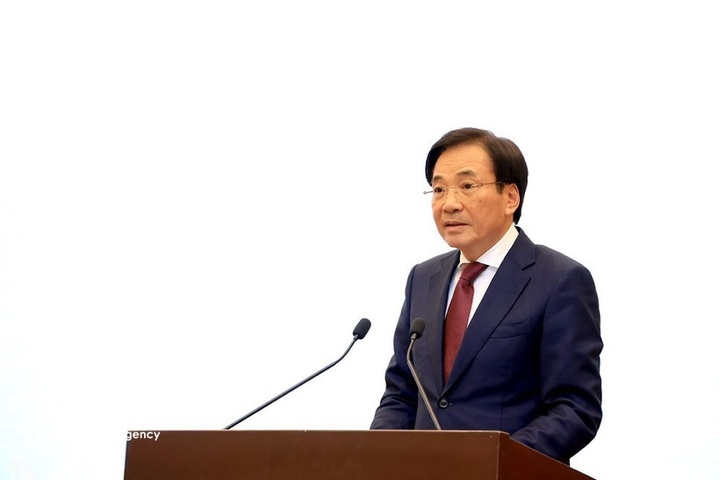
Minister and Spokesperson of the Government Tran Van Son speaks at the press conference on March 4 (Photo: VNA)
Tran Van Son, minister and government spokesperson, said on March 4 that the directive was issued at the government’s February meeting with localities, held online earlier the same day.
The meeting took place amid unpredictable global developments, including new US tariff measures and escalating Middle East tensions disrupting shipping, aviation and fuel markets. Domestically, ministries and localities are continuing to implement the resolution of the 14th national party congress and related politburo directives.
The government said socio-economic performance in the first two months of the year remained positive, with macroeconomic stability maintained, inflation controlled and major economic balances ensured. The average consumer price index rose about 3 per cent over the period.
All three economic sectors recorded growth. The index of industrial production rose an estimated 10 per cent in the first two months, while agricultural output remained stable. Total retail sales of goods and consumer service revenue increased about 8 per cent. The February purchasing managers’ index stood at 54.3, marking an eighth consecutive month of expansion.
State budget revenue reached an estimated VND 601 trillion (about USD 24 billion), equal to 23.8 per cent of the annual projection and up 13.1 per cent year on year. Total import-export turnover rose 22.2 per cent to USD 156 billion. Public investment disbursement reached 5.6 per cent of the yearly plan.
Newly registered foreign direct investment surged 61.5 per cent, while disbursed FDI increased 8.8 per cent. Around 64,500 enterprises were newly established or resumed operations, up 29.4 per cent year on year.
However, the government acknowledged ongoing pressures on macroeconomic management, inflation, exchange rates and interest rates, as well as volatile gold prices and persistent difficulties in some sectors.
In concluding remarks, Chinh urged strict implementation of the 14th national party congress resolution and proactive responses to Middle East tensions. He called for close coordination between flexible monetary policy and reasonably expansionary fiscal policy.
The prime minister also stressed the need to revitalise traditional growth drivers, develop new engines of expansion and accelerate public investment disbursement, aiming for full allocation of assigned capital in 2026 while speeding up key projects launched in 2025.
He called for stronger trade promotion, diversification of export markets and faster free trade agreement negotiations, alongside digital transformation, green transition, institutional reform and intensified anti-corruption efforts.