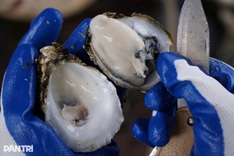
Nguyen Quoc Trong, 45, from Thuan Bai residential area in Bac Gianh Ward, operates five floating oyster rafts covering two hectares of the Gianh River.
One of the first local farmers to raise oysters in the river, Trong invested VND 100 million (USD 3,800) in cultivating milk oysters in 2020. However, flooding and unsuitable salinity levels caused heavy losses.
In late 2022, he learned about ocean oyster farming from an experienced friend and decided to try the new variety.

Trong said ocean oysters were better suited to the river's conditions, surviving prolonged exposure to freshwater and withstanding seasonal floods.
Following successful trials, he invested in two floating rafts before gradually expanding to five. Each raft required an initial investment of VND 350 million (USD 13,400), with oysters ready for harvest after 10-12 months.
Whole oysters currently sell for VND 30,000-35,000 per kilogramme, while cleaned oyster meat fetches VND 200,000 per kilogramme.
"Each raft generates more than VND 500 million in annual revenue, leaving a profit of around VND 150 million after expenses," Trong said.
"The advantage is that oysters feed naturally on algae and plankton, so we do not have to buy feed. But we still need to secure and protect the rafts against adverse conditions."
Encouraged by his success, other households in Bac Gianh Ward have also invested in oyster farming.
Farmers attach ropes carrying juvenile oysters to bamboo-framed floating rafts anchored more than 100 metres offshore near the river mouth.
Each raft measures 85 metres by 20 metres, while the ropes are more than a metre long and hold dozens of oysters.

Farmers source juvenile oysters from northern provinces and suspend them from bamboo supports. They say ocean oysters are hardier, less prone to disease and more tolerant of changing water conditions than milk oysters.
Another farmer, Nguyen The Anh, 42, from My Hoa residential area, has expanded his operation from six to 10 rafts, creating regular employment for five local workers.
His family staggers production, stocking oysters early in the year and harvesting towards year-end to supply the Tet market.
With 10 rafts, the family earns more than VND 1 billion (USD 38,300) in annual profit after expenses.
"Oyster farming is not particularly labour-intensive, but it carries risks," Anh said.
"Farmers must monitor water quality, oyster growth and weather conditions. Keeping the farming environment clean is especially important during the flood season, when poor management can wipe out an entire crop."
Building a local oyster brand
In September, eight farmers established the Bac Gianh Ward Ocean Oyster Farming Cooperative to strengthen production and marketing.
Known for their rich flavour, the oysters are used in dishes ranging from grilled oysters with spring onion oil or cheese to oyster porridge.
Although demand remains relatively stable, sales are largely confined to Quang Tri and neighbouring localities.
Farmers hope local authorities will help develop and promote the Bac Gianh oyster brand, expand distribution and create more jobs.
Tran Ngoc Huong, vice chairwoman of the Bac Gianh Ward People's Committee, said oyster farming must be developed alongside environmental protection and sustainable water management.

Annual oyster production in the ward is estimated at 900 tonnes, generating nearly VND 25 billion (USD 958,000) in revenue.
Local authorities plan to promote the oyster brand, explore further processing and recycle oyster shells to increase the industry's value.
Bac Gianh Ward also aims to develop Gianh River ocean oysters into a product under Vietnam's One Commune One Product (OCOP) programme, targeting a three- to five-star rating to improve market access and product value.