 |
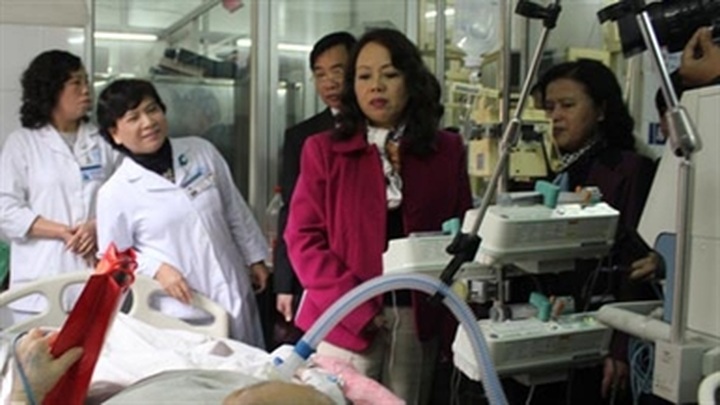
| Health Minister Nguyen Thi Kim Tien (in purple) in a visit to a hospital. |
Priority will be given to increasing the number of hospital beds, upgrading provincial and district level hospitals, and building satellite hospitals specialising in cancer, plastic surgery and other diseases, said the minister.
She also stressed the need to tighten control of the transfer of patients from grassroots-level medical centres to centrally-run establishments to avoid overcrowding and spreading infections.
She suggested developing private hospitals to ease the State’s public healthcare burden. However, she pointed out that private hospitals generally lack professional equipment and qualified doctors although they enjoy preferential capital, land, tax and administrative advantages.
Private hospitals are currently employing retired and inexperienced young doctors who do not inspire patients’ trust, said Tien.
She welcomed adjusting medical sector policies to attract outside resources for healthcare development, which would enable public hospitals to finance themselves, establish joint ventures, and purchase modern equipment.
Several hospitals are making full use of the self-finance mechanism and certain legal loopholes to cash in on services.
A comprehensive financial mechanism is needed during this transitional period so the medical sector can accomplish its assigned tasks, declared the minister.
According to Tien, in 2012 the Ministry of Health will ask the government to consider two decrees on renewing the financial mechanism for hospitals and adjusting the cost of hospital services.
For the time being, it will pilot a project to reduce the overload at K (Cancer) and Bach Mai Hospitals, two leading centrally-run hospitals in Hanoi, and several departments at other major hospitals.
“Overload cannot be reduced overnight, it needs synchronous solutions, including speeding up land clearance to build satellite hospitals” said Tien.
She confirmed that the master plan will pay off in 2015, and Hanoi and Ho Chi Minh City will be the pioneers in putting it in place.
Vice Chairwoman of the National Assembly Tong Thi Phong asked the medical sector to build more grassroots-level medical centres, especially in remote areas and improve the capacity of local centres to nip in the bud any infectious epidemics, while concentrating on primary healthcare education.
Phong also suggested that the sector pay attention to renewing the financial mechanisms, implementing medical insurance programs, training and re-training medical workers, and taking care of the workers financially and ethically to ensure they can focus on their jobs.