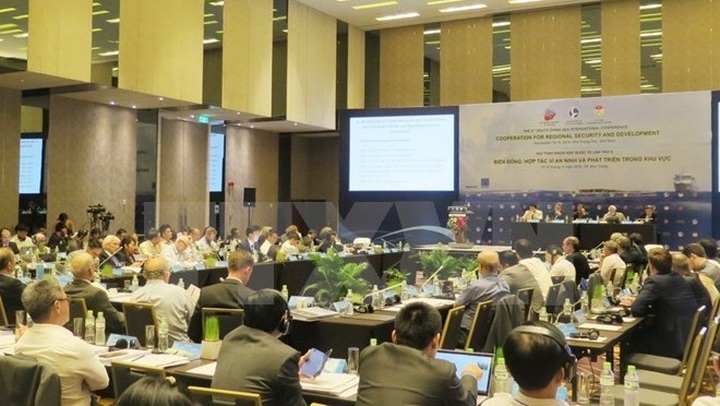
Scene at the conference
Through the course of seven sessions with 28 presentations and nearly 200 opinions, delegates held heated discussions on the regional and global situation, recent happenings in the East Sea, legal, economic, political, security and historic aspects of the East Sea dispute and prospects for the settlement and management of disputes in the region.
Commenting on the origin of the East Sea dispute, many participating scholars said it began decades ago, saying that the nine-dash line claimed by China serves to initially define sovereignty over islands without resorting to any legal and scientific grounds.About the recent developments in the East Sea, they shared view that China is likely to reach consensus with several Southeast Asian countries to soften disputes, but on the ground, it has still maintained or even strengthened its presence and control in the area, including the Scarborough Shoal and the Truong Sa (Spratly) Archipelago.
The construction and installation of equipment for military purposes and surveillance in Da Chu Thap (Fiery Cross Reef), Vanh Khan (Mischief Reef) and Subi Reef have not been slowed down, proving that China has not changed its long-term goal of gaining full control over the East Sea, which is an important cause of regional tensions.
Underscoring ASEAN’s central role in managing East Sea disputes, they said countries are still concerned about China’s activities in the East Sea, given that the US’s policy towards the Asia-Pacific under the new administration remains unclear.
With regards to political and economic considerations, scholars agreed that in order to ensure regional security and stability, parties concerned need to exercise self-restraint, maintain the status quo and avoid unilateral actions in the East Sea such as militarising occupied areas and declaring the Air Defence Identification Zone.
They called for establishing mechanisms to manage conflicts in fishing, fuel production and the protection of the marine environment.
Regarding legal considerations, participants said the ruling by the Permanent Court of Arbitration acknowledges that past developments in the East Sea run counter to the regulations of the 1982 United Nations Convention on the Law of the Sea.
According to them, the conclusions of the ruling open up a chance for cooperation in fields of common interest, such as fishing, maritime safety and environmental conservation.
Several opinions suggested developing mechanisms on bilateral or trilateral cooperation for parties in the East Sea, developing a code of conduct for unplanned encounters at sea and coordinating in protecting the environment and fisheries resources.
Others proposed holding dialogues between maritime law enforcement forces from countries bordering the East Sea, building a marine park and enhancing collaboration among scientists.
Mechanisms such as the International Tribunal for the Law of the Sea, the Commission on the Limits of the Continental Shelf and the International Seabed Authority should be used effectively, they said.
Members of the annual Young Leaders Programme suggested building a network of young researchers on the East Sea issue and the conservation of the marine environment, enhancing liaisons between the parties concerned.
In his closing speech, Director of the Diplomatic Academy of Vietnam Associate Professor Nguyen Vu Tung urged the parties concerned to take constructive action, to respect each other and to abide by international law.
The conference took place in an open, straightforward and practical manner and showed a meaningful effort to contribute to promoting international cooperation for peace and stability in the East Sea, he said.