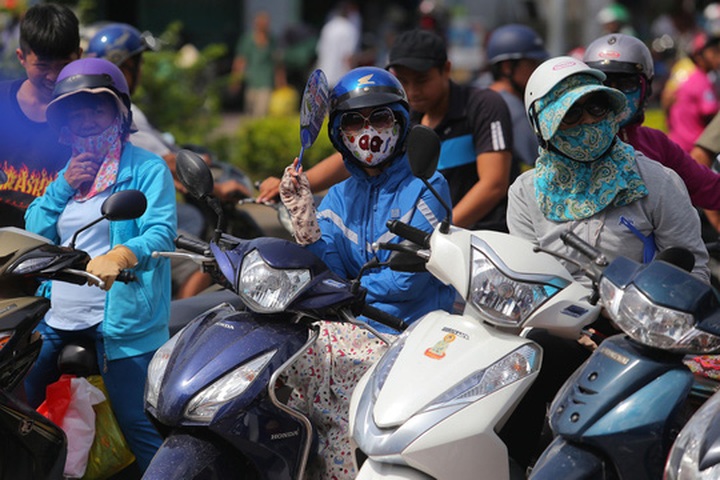
Citizens advised to protect their skin and eyes
A UV Index of 11 or more means extreme risk from unprotected sun exposure including skin cancer. According to WeatherOnline, the UV index in HCM City reached 12 on March 26.
Le Dinh Quyet, deputy director of the Southern Centre for Hydro-Meteorological Forecasting’s Forecast Department, said that the heat was caused by two different weather patterns including the subtropical high pressure and the hot low-pressure from the west.
He went on to say that the UV index depends on the distance between the earth and the sun. Moreover, the thinning ozone layer is no longer an effective barrier. The hot spell will last until late March in HCM City. However, after one or two days with cooler weather, the southern region will have more heat waves.
Dr Nguyen Trong Hao, director of HCM City Hospital of Dermatology, said long exposure to the sun could cause both immediate and lasting consequences including burning, skin ageing and skin cancer.
Truong Quang Anh Vu from Thong Nhat Hospital also warned about heatstroke, especially in relation to old people and those with illnesses.
According to the World Health Organisation, altitude, latitude, cloud, and air pollution all have effects on the UV index. With every 1,000 metres increase in altitude, UV radiation levels increase by 10% to 12%. The radiation levels are higher at countries near the equator.
It is estimated that 10% depletion of the ozone layer would lead to a 26% increase in non-melanoma skin cancer and 1.75 million cataract cases. People are advised to avoid going outside from 10 am to 4 pm, take advantage of shaded spots, and protect their skin and eyes when going out.