The municipal People's Council on the morning of October 30 approved a resolution regulating free trade zones and integrated logistics zones, establishing a legal framework for their formation, boundary and area adjustments, management mechanisms and investment incentives.
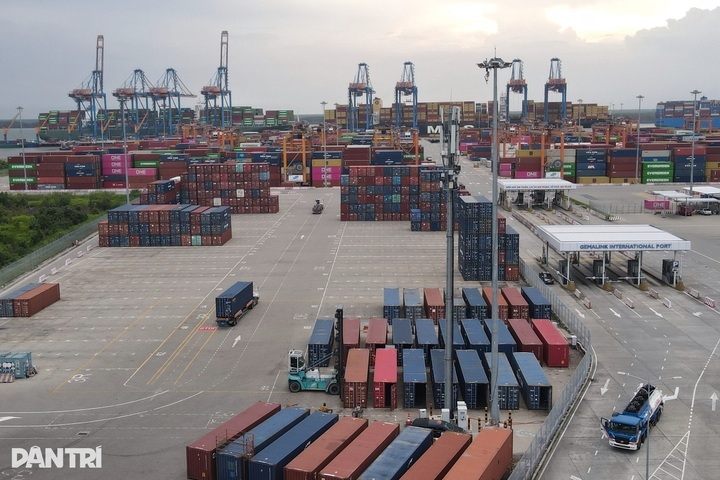
Ho Chi Minh City's free trade zone will be linked to the Cai Mep Ha seaport area (Photo: Phuoc Tuan).
Free trade zones must meet several requirements concerning location, size, infrastructure and development plans. In terms of transport connectivity, they must be adjacent to or directly connected with international seaports, international airports, the international financial centre, major international border gates or other strategic logistics infrastructure.
Each free trade zone must cover at least 1,000 hectares. Its functional areas do not need to be contiguous but must be linked through infrastructure, operations and management in accordance with regulations.
Proposals to establish such zones must clearly define their functional areas, development orientations, investment needs and ability to mobilise resources. Essential technical infrastructure must be sufficient for operations, while ensuring links and complementarity with economic zones, industrial parks, high-tech parks and relevant logistics centres.
The resolution sets separate establishment requirements for integrated logistics zones, whether they are located inside or outside free trade zones.
Such zones must have geographical boundaries adjacent to or directly connected with at least one transport hub, including a seaport, airport, railway station, inland container depot, international border gate, multimodal transport centre or strategic logistics corridor.
If the connecting infrastructure has not yet been completed, it must be included in an approved planning or investment programme, with a schedule aligned with the zone's operational timeline.
Integrated logistics zones must be capable of connecting at least two modes of transport and operate as integrated logistics ecosystems combining logistics services with manufacturing, goods processing, digital trade and e-commerce.
They must also have plans to apply technology and digital infrastructure, enable traceability and data sharing, introduce automation and connect with e-commerce platforms. Their infrastructure and operations must meet requirements for safety, fire prevention and fighting, and environmental protection.
Investment plans must also prioritise efficient resource and energy use, emissions reduction and green construction suited to the scale and nature of operations.
Under the resolution, infrastructure projects in free trade zones are included in the list of projects prioritised for attracting strategic investors under the Law on Urban Development.
Specifically, seaport construction projects must have investment capital of at least VND 75 trillion (USD 2.88 billion); projects to build and operate integrated logistics zone infrastructure must involve at least VND 25 trillion; and projects developing and operating infrastructure for industrial, urban and service functional areas must have investment capital of at least VND 20 trillion.