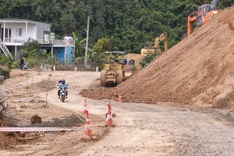
On October 30, project developer VinSpeed High-Speed Railway Investment and Development JSC and the Vinhomes-SGC contractor consortium expanded construction across several major sections of the line.
The project aims to complete construction and trial operations in the fourth quarter of 2028, ahead of commercial services in 2029.

Construction of the Ben Thanh-Can Gio railway began in December 2025, with geological surveys, site preparation, access roads and work on the Can Gio depot and several bridges already underway.
Three precast beam yards have also been established, with the first trial beam successfully produced at the initial facility.
Contractors expect to mobilise up to 10,000 workers, engineers and technical personnel simultaneously during peak construction periods.
New construction fronts will focus on Ben Thanh Station, the Saigon Port tunnel section, the Rach Dia and Ong Doi bridges, approach bridges to Can Gio Bridge and elevated sections where land has been handed over.
To accelerate construction, the project will make greater use of prefabricated components and industrialised construction methods.
Around 1,300 full-span precast prestressed concrete box girders will be manufactured at three production yards over approximately 15 months, with each yard producing an average of one to two spans a day.
The developer has ordered 32-metre girder moulds and 900-tonne transport and launching equipment.
In the city centre, the underground Ben Thanh Station will extend 565.85 metres, with an excavation depth of approximately 34 metres, and connect to the existing Ben Thanh Station on Metro Line 1.
The Saigon Port tunnel section will include a 2,019-metre tunnel excavated by a 13-metre-diameter tunnel boring machine, connecting to a 321.7-metre cut-and-cover tunnel and a 266-metre U-shaped open section.
Other major structures include the Can Gio depot and the main Can Gio Bridge across the Soai Rap River.
The cable-stayed bridge will feature steel truss girders, two A-shaped towers, a 360-metre main span and approximately 4.4 kilometres of approach bridges.
HCM City People's Committee Vice Chairman Hoang Nguyen Dinh said Can Gio had considerable potential for maritime economic development, tourism and services.
He said the railway would improve transport connectivity, attract investment and help unlock the area's economic potential.
Coordinated development of transport infrastructure, urban areas, commercial facilities and services is expected to create a new growth centre in the city's south.
Local authorities are expected to complete land handovers for the entire project in the fourth quarter of 2026.
The developer said construction would be closely monitored to ensure quality, safety, technical standards and environmental protection.
The Ben Thanh-Can Gio high-speed railway will extend approximately 54 kilometres, with a maximum design speed of 350 kilometres per hour.
Once operational, trains are expected to run at five-minute intervals, significantly reducing travel time between central HCM City and the Can Gio coastal urban development.