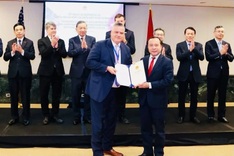
The project is among several major infrastructure developments scheduled to break ground on July 1 as Ho Chi Minh City marks the 50th anniversary of officially being named after President Ho Chi Minh on July 2, 1976.

Under the design plan, the two tunnel portals will be built in the shape of lotus flowers. Each portal will incorporate the main approach road to the immersed tunnel, internal access roads, and supporting infrastructure, including power supply, water and drainage systems, lighting, landscaping and an operations building.

The tunnel portal structures are designed not only to reduce the length of the bridge or immersed tunnel but also to accommodate essential technical facilities such as ventilation, rescue and emergency response systems, maintenance areas and operational equipment. They are also expected to lessen the impact of waves, currents and sediment, improving safety and extending the lifespan of the sea crossing.
The project will also feature a bridge span inspired by the shape of a lotus flower, creating an additional architectural landmark along the route.
The Can Gio-Vung Tau sea crossing will stretch approximately 14 kilometres, including approach roads, an offshore bridge and an immersed tunnel. The bridge section will extend for more than 8 kilometres, while the immersed tunnel will measure more than 3.8 kilometres.
The entire route will comprise six traffic lanes. The immersed tunnel will be approximately 34.6 metres wide, the bridge 26.25 metres wide, and the approach roads around 34.5 metres wide.
The project carries a preliminary investment of more than VND 93 trillion (approximately USD 3.55 billion) and is scheduled for completion in 2029.
Once operational, the route is expected to reduce travel time between Can Gio and Vung Tau to about 15 to 20 minutes, compared with the current 90 to 120 minutes.
The new crossing is expected to establish a continuous transport corridor linking the urban core of Ho Chi Minh City with its southeastern coastal area, creating new opportunities for urban expansion.
The project is also expected to support the development of the Can Gio coastal tourism area, the Long Son Industrial Zone and the Cai Mep-Thi Vai Port complex, while boosting the marine economy, logistics and eco-tourism in line with the city's long-term coastal urban development strategy.