The collection, presented by Dantri/Dtinews, documents key moments from the 1954 campaign that ended French colonial rule in Indochina and reshaped modern Vietnamese history.

One photograph shows Ho Chi Minh meeting with senior leaders including Vo Nguyen Giap, Truong Chinh and Pham Van Dong in December 1953 to approve the campaign plan.
Ho Chi Minh described the operation as vital not only militarily and politically, but also internationally, urging the entire nation to ensure victory “at all costs”.
The images also highlight the immense logistical effort behind the campaign. Tens of thousands of civilian labourers, freight bicycles, boats and horses transported food, weapons and ammunition across mountains and rivers to support frontline troops.

General Vo Nguyen Giap reviews anti-aircraft artillery units in 1954.

Civilian labourers enthusiastically cross deep streams as they move closer to the front in 1954.

Some 21,000 freight bicycles, 261,500 civilian labourers, along with lorries, ships, boats, mules and horses, transported food, weapons and ammunition to the Dien Bien Phu front day and night. The enormous contribution of the civilian labour force, which secured logistics for the campaign, helped deliver victory.

Troops and ethnic minority communities in the north-west cut through mountains to build roads to the battlefield.
Other photographs depict soldiers hauling artillery through rugged terrain, constructing roads and preparing defensive positions around Dien Bien Phu.

Troops haul artillery pieces into the Dien Bien Phu front.
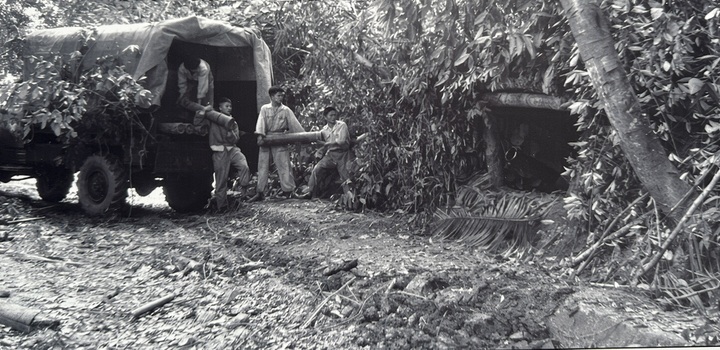
Ammunition is moved into an artillery bunker at the Dien Bien Phu front.

A 105mm howitzer unit prepares to head to the Dien Bien Phu battlefield.

The campaign unfolded in three phases, beginning with the assault on the Him Lam stronghold on March 13, 1954. Fierce battles later centred on strategic positions including Hill C1 and Hill A1, where Vietnamese troops fought prolonged hand to hand combat against French forces.

Vietnamese troops attack Hill C1.

Vietnamese troops seize Muong Thanh Bridge and advance straight into central Muong Thanh.

Vietnamese forces capture Hill A1.

One of the most iconic images shows Vietnamese soldiers raising the “Determined to fight, determined to win” flag above the French command bunker after the capture of General Christian de Castries on May 7, 1954.

French troops surrender on Muong Thanh Bridge.

General de Castries and the French military staff at Dien Bien Phu are captured alive by Vietnamese forces.

The victory at Dien Bien Phu became a turning point in anti colonial movements worldwide. Ho Chi Minh later described it as “a brilliant golden landmark in history” comparable to Vietnam’s historic victories at Bach Dang, Chi Lang and Dong Da.
The archive also includes photographs of victory celebrations, including scenes of soldiers lifting Vo Nguyen Giap in celebration days after the campaign ended.

Today, sites such as A1 Hill and Muong Thanh Bridge remain preserved as part of the Dien Bien Phu battlefield relic complex, attracting visitors seeking to understand one of the 20th century’s most significant military campaigns.
(Photos: VNA archives, National Archives Centre III)